
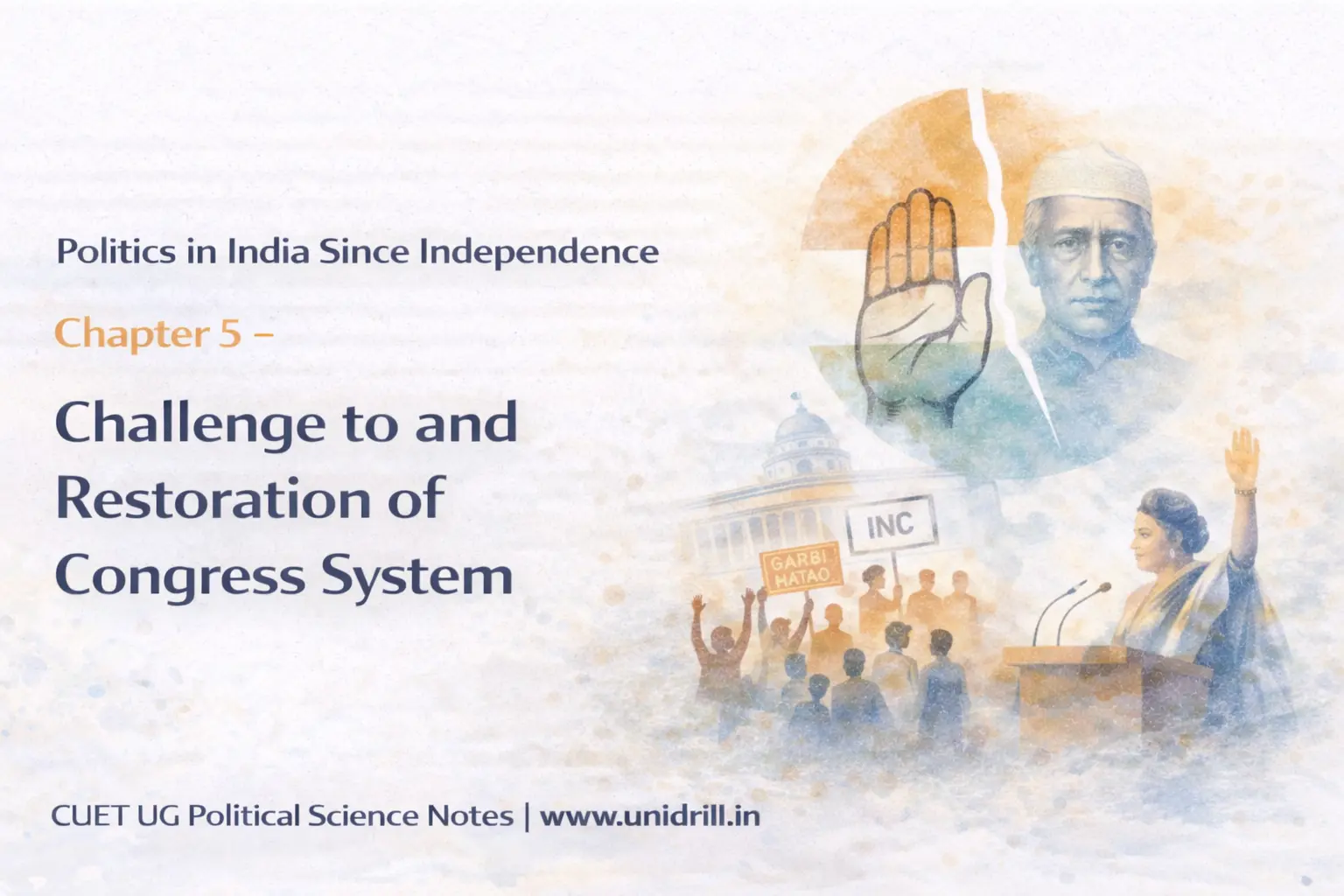
Crisis of Succession and Decline of Congress Dominance (1964–1967)
I. Introduction: Transition from Dominance to Uncertainty
The Congress system, which had ensured political stability since independence, began to face serious challenges during the 1960s.
Increasing political competition and internal factionalism weakened its earlier ability to accommodate diverse interests.
The central question shifted from mere leadership succession to the future of democratic stability in India.
II. Challenge of Political Succession after Nehru
A. Nature of the Crisis
Nehru’s death (1964) triggered dual concerns:
Who will succeed him?
More importantly: Will Indian democracy survive?
The 1960s described as a “dangerous decade”, marked by poverty, inequality, and social divisions.
B. Smooth Transition: Nehru to Shastri
Selection of Lal Bahadur Shastri through consensus-building within Congress.
Demonstrated maturity of democratic procedures, disproving fears of instability.
Shastri’s leadership marked by:
Simplicity and moral accountability
Crisis management: food shortages, economic distress, and the 1965 Indo-Pak war
Symbolism of “Jai Jawan, Jai Kisan”
C. Second Succession Crisis: Shastri to Indira Gandhi
Sudden death of Shastri (1966) reopened succession struggle.
Contest between Morarji Desai and Indira Gandhi resolved through intra-party electoral process.
Indira Gandhi’s victory signified:
Internal democracy within Congress
Continuity of constitutional governance
III. Early Challenges Before Indira Gandhi
Perceived as politically inexperienced and dependent on senior leaders.
Faced:
Economic crisis (drought, inflation, food shortages)
Political instability
Began consolidating authority by asserting independence from party bosses.
IV. The Fourth General Elections, 1967: A Turning Point
A. Context of the Elections
Economic decline:
Agricultural failure, industrial slowdown, rising prices
Political unrest:
Protests, bandhs, dissatisfaction with governance
Government’s inability to interpret protests as expressions of public distress deepened alienation.
B. Rise of Opposition Unity: “Non-Congressism”
Opposition parties overcame ideological differences to form anti-Congress fronts.
Ram Manohar Lohia’s theory:
Congress rule seen as undemocratic and anti-poor
Opposition unity necessary to restore democracy
V. Electoral Verdict of 1967
A. At the National Level
Congress retained majority but with reduced strength and legitimacy.
Loss of prominent leaders signified weakening of party dominance.
B. At the State Level: Collapse of Congress Monopoly
Congress lost power in nine major states.
Emergence of:
Regional parties (e.g., DMK in Tamil Nadu)
Coalition governments
VI. New Political Trends Post-1967
A. Coalition Politics
Formation of Samyukta Vidhayak Dal (SVD) governments.
Ideologically diverse coalitions indicated:
Rise of pragmatic politics
Decline of single-party dominance
B. Defections and Political Instability
Frequent party-switching (“Aya Ram, Gaya Ram”) destabilised governments.
Highlighted weaknesses in party discipline and ideological commitment.
VII. Conclusion: End of One-Party Dominance
1967 elections marked a structural shift in Indian politics:
Congress dominance challenged
Rise of competitive, fragmented party system
However, no clear alternative system had yet consolidated power.
Congress Split and Ideological Reorientation (1967–1969)
I. Aftermath of 1967: Congress in Crisis
Congress retained power at the Centre but:
Lost political authority
Faced internal divisions
Opposition governments unstable → no immediate replacement of Congress system.
II. Internal Power Struggle: Indira Gandhi vs. Syndicate
A. Nature of the Syndicate
Informal group of powerful Congress leaders controlling organisation and policy.
Expected Indira Gandhi to remain dependent on them.
B. Indira Gandhi’s Strategy
Gradually asserted independence by:
Selecting her own advisors
Sidelining Syndicate leaders
Transformed internal power struggle into an ideological conflict.
III. Shift Towards Left-Oriented Policies
Adoption of Ten-Point Programme (1967):
Social control of banks
Nationalisation of insurance
Land reforms and redistribution
Public distribution system
Reflected attempt to build pro-poor image and mass support base.
IV. Presidential Election of 1969: Turning Point
A. Conflict Over Candidate
Syndicate supported N. Sanjeeva Reddy
Indira Gandhi supported V.V. Giri (independent candidate)
B. Political Strategy
Called for “conscience vote” → defied party discipline
Announced populist measures:
Bank nationalisation
Abolition of privy purse
C. Outcome
Victory of V.V. Giri → defeat of Syndicate
Marked decisive assertion of Indira Gandhi’s authority
V. Split in the Congress (1969)
Congress divided into:
Congress (Organisation) – Syndicate faction
Congress (Requisitionists) – Indira Gandhi faction
Indira Gandhi framed split as:
Socialists vs conservatives
Pro-poor vs pro-rich
VI. Ideological and Political Significance
Shift from organisational politics to leader-centric politics
Rise of populism as a key political strategy
Weakening of internal party democracy
VII. Abolition of Privy Purse: Symbolic Politics
Reflected commitment to equality and social justice.
Became a major political issue mobilising public support.
Demonstrated use of policy as political instrument.
VIII. Conclusion: Transformation of Congress
Congress was no longer a broad-based consensus party.
It became:
Centralised
Ideologically sharper
Dependent on leadership charisma
Restoration of Congress Dominance and Its New Character (1971–Early 1970s)
I. Context Leading to 1971 Elections
Congress split reduced government to minority.
Continued through issue-based support from other parties.
Indira Gandhi sought fresh mandate to:
Strengthen position
End dependence on allies
II. The 1971 General Elections
A. Nature of the Contest
Opposition formed Grand Alliance (anti-Indira coalition).
Lacked coherent ideology or programme.
B. Indira Gandhi’s Strategy
Presented clear ideological agenda:
“Garibi Hatao” (Remove Poverty)
Focus areas:
Public sector expansion
Land reforms
Redistribution of wealth
Targeted support from:
Poor, landless labourers, Dalits, minorities, women, youth
III. Electoral Outcome
Massive victory for Congress (R):
352 seats, ~44% vote share
Grand Alliance decisively defeated.
Congress re-established as dominant political force.
IV. Consolidation of Power (1971–1972)
Success in Bangladesh crisis and war enhanced legitimacy.
Victory in 1972 state elections restored Congress rule nationwide.
Indira Gandhi emerged as:
Popular mass leader
Strong nationalist figure
V. Nature of the “Restored” Congress System
A. Differences from Old Congress System
Earlier system:
Broad coalition of interests
Strong organisational structure
New system:
Leader-centric
Weak internal factions
Limited accommodation of diverse views
B. Social Base of Support
Shift towards:
Marginalised groups
Economically weaker sections
VI. Limits and Contradictions
Despite electoral success:
Reduced space for democratic dissent
Growth of popular unrest
Centralisation weakened institutional functioning.
VII. Critical Evaluation
Restoration was not revival but reinvention:
Congress regained dominance
But changed its nature fundamentally
Politics became:
More populist
Less institutional
More dependent on charismatic leadership
VIII. Conclusion: Transition to a New Political Phase
Indira Gandhi successfully:
Overcame internal and external challenges
Re-established Congress dominance
However:
The transformed system carried seeds of future crisis
Led to tensions between popular mobilisation and democratic institutions