
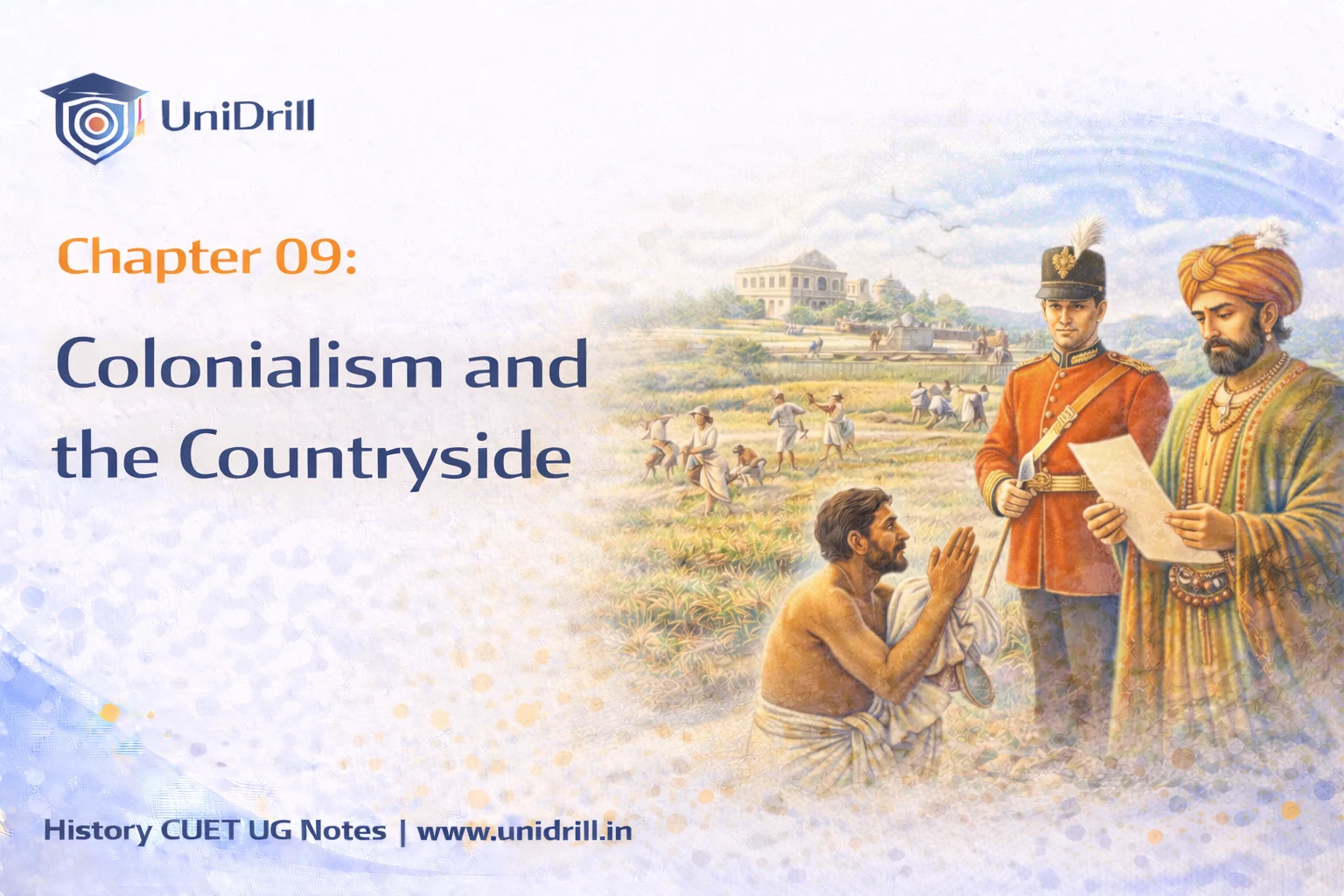
Colonial Rule, Zamindars, and Agrarian Restructuring in Bengal
Colonial rule in India brought about profound transformations in the countryside, particularly through the introduction of new laws and revenue systems that restructured rural society.
These laws determined not only patterns of land ownership and agricultural production but also shaped social hierarchies and economic relationships.
However, rural society was not merely a passive recipient of these changes; peasants, zamindars, and other groups actively negotiated, resisted, and adapted to colonial policies, thereby influencing their outcomes.
Bengal was the first region where the British East India Company established its control and experimented with agrarian policies. In the late eighteenth century, the Company faced a severe crisis in revenue collection due to declining agricultural productivity and recurring famines.
To stabilise its income and encourage agricultural investment, the Company introduced the Permanent Settlement in 1793.
Under this system, the revenue demand of the state was fixed permanently, and zamindars were recognised as the key intermediaries responsible for collecting revenue from the peasants and paying it to the Company.
The underlying assumption of this system was that by guaranteeing a fixed revenue demand, zamindars would feel secure in their rights and invest in improving agricultural productivity.
The Company also expected the emergence of a class of prosperous landlords and yeomen farmers who would support colonial rule. However, this vision was based on flawed assumptions.
Zamindars were not absolute landowners but rather revenue collectors with obligations to the state. They collected rent from villages and retained the surplus after paying the fixed revenue.
The implementation of the Permanent Settlement soon revealed serious problems. One striking example is the auction of the Burdwan estate in 1797, where the estates of the raja were put up for sale due to unpaid revenue.
Although many buyers appeared at the auction, most of the purchases were fictitious, carried out by agents of the zamindar himself. This episode illustrates how colonial policies were often subverted in practice.
The failure of zamindars to meet revenue demands became widespread. Several factors contributed to this crisis.
First, the revenue demand was set excessively high, as the Company sought to maximise its income.
Second, agricultural prices were depressed in the 1790s, making it difficult for peasants to pay rents.
Third, the revenue had to be paid punctually under the rigid “Sunset Law,” regardless of harvest conditions.
Finally, the Company curtailed the traditional powers of zamindars by disbanding their armed forces, limiting their judicial authority, and placing them under the supervision of colonial officials.
As a result, many zamindars lost control over their estates, and a significant proportion of zamindaris were auctioned. However, this did not necessarily mean the complete decline of zamindari power.
Zamindars adopted various strategies to retain control, including benami transactions and manipulation of auctions. Moreover, they continued to enjoy social authority, as many peasants remained loyal to them and resisted the entry of outsiders.
At the same time, a new class of rural elites emerged in Bengal—the jotedars. These were wealthy peasants who acquired large tracts of land and exercised considerable economic and social power within villages.
Unlike zamindars, who often lived in urban areas, jotedars were directly involved in village life. They controlled local trade and moneylending, and their land was cultivated by sharecroppers who gave them a portion of the produce.
The rise of the jotedars significantly altered the balance of power in rural society. They resisted attempts by zamindars to increase rents, mobilised peasants against them, and often purchased estates that were auctioned due to default. In many regions, their authority became more effective than that of zamindars.
Our understanding of these developments is shaped in part by official sources such as the Fifth Report of 1813, which provided detailed information on revenue administration and agrarian conditions.
While this report is an invaluable source, it must be read critically, as it was influenced by political debates in Britain and may have exaggerated the decline of zamindars to criticise Company rule.
In conclusion, colonial policies in Bengal did not create a stable agrarian order as intended. Instead, they generated economic distress, reshaped social hierarchies, and led to the emergence of new forms of power and resistance in the countryside.
Tribal Societies, Forest Economies, and Colonial Expansion
While the Bengal plains experienced changes in revenue systems and land relations, the forested and hilly regions such as the Rajmahal hills witnessed a different but equally significant transformation. These regions were inhabited by tribal communities like the Paharias, whose way of life was closely tied to the forest.
The Paharias practised shifting cultivation, clearing patches of forest by burning vegetation and cultivating crops for a few years before moving to new areas. Their economy was diverse and included hunting, gathering forest produce, charcoal production, and silkworm rearing.
For them, the forest was not merely a resource but the basis of their identity and survival. They considered the entire region as their land and resisted the intrusion of outsiders.
The political organisation of the Paharias was centred around their chiefs, who maintained social order and led the community in conflicts. Raiding the plains was an integral part of their livelihood, especially during times of scarcity.
These raids also served as a means of asserting power and negotiating relationships with settled communities. Zamindars and traders often paid tribute to Paharia chiefs to ensure safe passage and protection.
However, this relatively autonomous way of life came under threat with the expansion of colonial rule. The British viewed forests as unproductive and tribal people as primitive and difficult to govern. They sought to transform these regions by clearing forests, expanding settled agriculture, and integrating them into the colonial economy.
The expansion of agriculture led to increased conflict between the Paharias and settled cultivators. In response, the British initially adopted a policy of violent suppression, attempting to eliminate resistance through military force.
When this proved ineffective, they shifted to a policy of pacification under officials like Augustus Cleveland, offering allowances to tribal chiefs in return for maintaining order. However, this policy undermined traditional authority and did not fully integrate the Paharias into the colonial system.
The situation changed dramatically with the arrival of the Santhals, who were encouraged by the British and zamindars to settle in the region. Unlike the Paharias, the Santhals were willing to clear forests and practise settled agriculture. They were seen as ideal settlers who could expand cultivation and increase revenue.
In 1832, a large area known as Damin-i-Koh was demarcated for the Santhals. Within a few decades, the region witnessed rapid growth in population and cultivation. The Santhals transformed the landscape by clearing forests and cultivating commercial crops, thereby contributing significantly to the colonial economy.
However, this transformation came at a cost. The Paharias were displaced from their lands and forced to retreat into less fertile areas, leading to the decline of their traditional way of life. At the same time, the Santhals themselves became victims of exploitation. They faced heavy taxation, were subjected to the control of zamindars, and fell into debt due to the activities of moneylenders.
These pressures eventually led to the Santhal Revolt of 1855–56, in which the Santhals rose against the colonial state, zamindars, and moneylenders in an attempt to establish an independent order. Although the revolt was suppressed, it led to the creation of the Santhal Pargana and the introduction of special administrative measures.
Our knowledge of these developments is also shaped by the accounts of officials like Buchanan, whose writings reflect the priorities and biases of the colonial state. While he provided detailed observations, his perspective was influenced by the Company’s interest in resource exploitation and agricultural expansion.
Thus, the transformation of the Rajmahal hills illustrates the disruptive impact of colonial policies on tribal societies, leading to displacement, conflict, and resistance.
The Deccan Riots and Peasant Resistance
The changes brought about by colonial rule were not limited to eastern India. In the Bombay Deccan, new revenue systems and economic pressures led to widespread peasant unrest, culminating in the Deccan Riots of 1875. These revolts provide valuable insights into the conditions of rural society and the nature of colonial exploitation.
The riots began in the village of Supa in Poona district, where peasants attacked moneylenders and burned their account books and debt bonds. The movement quickly spread across a large area, affecting numerous villages. The actions of the peasants were not random acts of violence but targeted attacks on the instruments of their oppression.
To understand the causes of this revolt, it is necessary to examine the agrarian system introduced in the region. Unlike Bengal, where the Permanent Settlement was implemented, the British introduced the ryotwari system in the Deccan. Under this system, revenue was settled directly with the peasants (ryots), who were recognised as individual landholders.
The revenue demand was based on an assessment of the land’s productivity and was subject to periodic revision. While this system eliminated intermediaries like zamindars, it placed a heavy burden on peasants, who were required to pay revenue regardless of their actual income. In times of poor harvest, they were forced to borrow money to meet these demands.
Moneylenders (sahukars) played a crucial role in this system. They provided loans to peasants but charged high rates of interest and used legal mechanisms to enforce repayment. Over time, many peasants became heavily indebted and lost their land to moneylenders.
The burning of account books during the riots symbolised a rejection of this exploitative system. By destroying the records of debt, peasants sought to free themselves from the cycle of indebtedness and assert their sense of justice. The revolt thus reflected a moral economy in which peasants challenged the legitimacy of colonial laws and practices.
The British response to the riots was swift and severe. Police and military forces were deployed, and hundreds of peasants were arrested. At the same time, the colonial state attempted to understand the causes of the unrest by appointing the Deccan Riots Commission, which produced detailed reports on the conditions of the countryside.
However, official accounts often reflected the biases of the colonial administration, portraying peasants as violent and irrational. A critical reading of these sources reveals the underlying grievances and structural inequalities that led to the revolt.
In a broader sense, the Deccan Riots were part of a pattern of peasant resistance across colonial India. They highlight the tensions inherent in the colonial agrarian system and demonstrate that rural society actively resisted exploitation and injustice.