
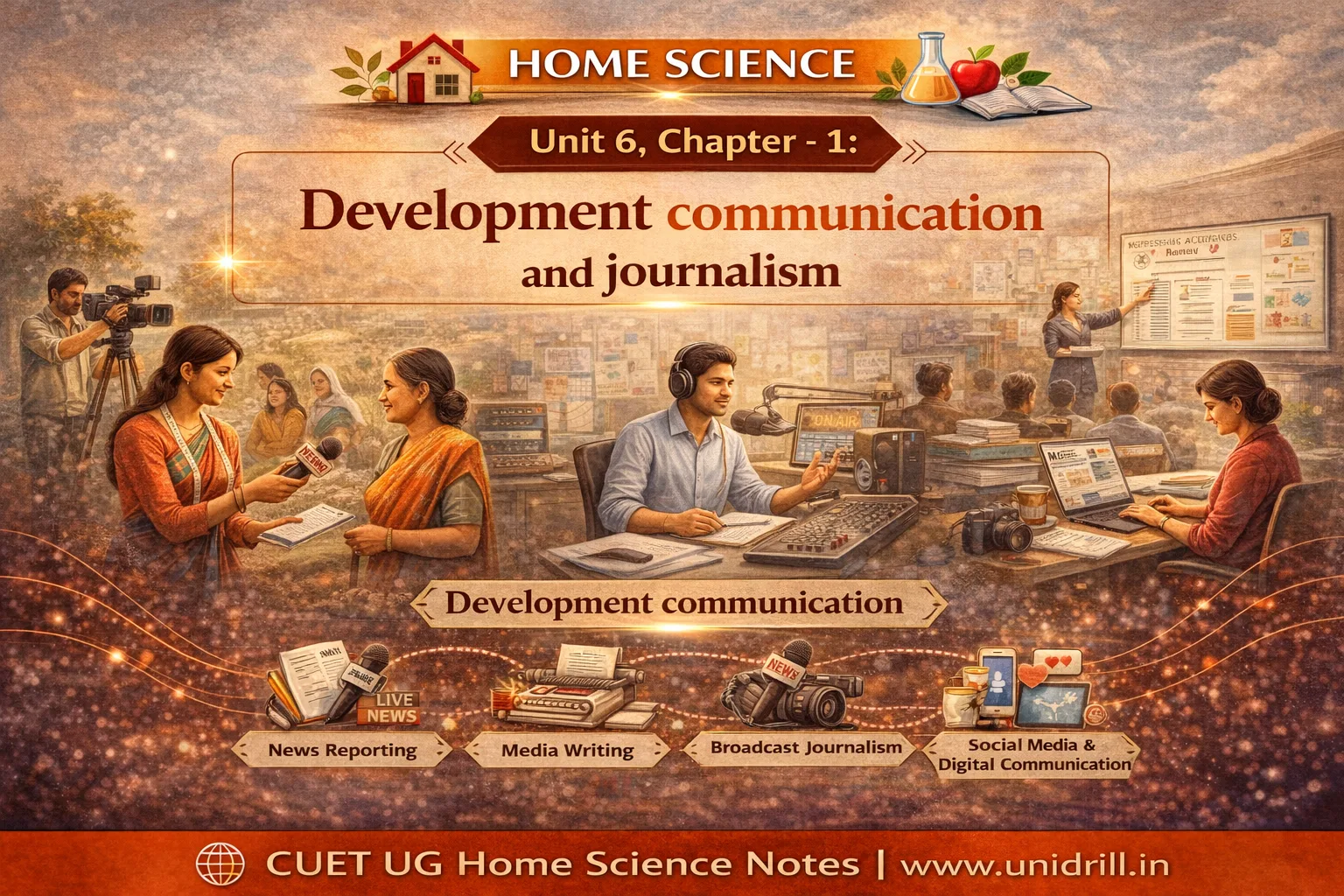
I. Introduction to the Discipline
Communication is an integral part of our social and professional life. In India, there is a concerted effort to reach higher levels of development and to ensure that benefits reach all, including the vast rural population.
Today’s ‘information society’ needs to tackle this crucial challenge by using the discipline of Communication and Extension to create awareness, sensitise, educate, and empower the masses.
Communication and Extension Education are crucial ingredients in the country’s endeavours to respond to the needs of families and communities for promoting their development.
This discipline integrates theory and practice in planning development programmes, media, and communication.
It allows students to analyse development programmes, policies, and the role of mass media and journalism in the process of development.
II. Core Concepts: Development, Journalism, and Communication
Understanding the specific terminology within this field is essential for CUET preparation.
Development: This refers to positive changes in the socio-economic and cultural lives of the majority of people on a permanent basis without exploitation or violence. Development in most parts of the world calls for intensive efforts to tackle problems such as mass illiteracy, population growth, malnutrition, poor health, hunger, and pollution.
Development Journalism: This is a relatively newer concept that emerged after the end of the colonial era. Prior to independence, reporting primarily focused on struggles, assassinations, disasters, and wars as chosen by colonial rulers. Today, development journalism focuses on success stories of people who have adopted new technologies, tried new methods, and helped society. It seeks to describe people at work in new projects and processes. Through various media, the journalist communicates the feelings of the community to the community.
Development Communication: This is the practice of systematically applying the processes, strategies, and principles of communication to bring about positive social change. The term was first coined in 1972 by Nora Quebral. It is defined as the ‘art and science of human communication’ used for facilitating the development of a disadvantaged society in a planned manner to ensure equity and the achievement of individual potential.
III. Significance of Development Communication
Communication creates awareness about available technologies and mobilises people to use them for the betterment of society. It acts as a vital link between Government agencies, NGOs, and the people.
These fields of study sensitise students to the process of development and train them to write or speak about issues related to an equitable and impartial society.
The ultimate aim is to equip media professionals, campaigners, and journalists with the practical
skills needed to deepen their knowledge of development issues.
In a democratic system, journalism is an inseparable part, with the Press often referred to as the “fourth pillar of democracy”.
IV. Essential Features of Development Communication
Development communication is characterised by several key features:
It is oriented toward the socio-economic development and happiness of the community at large.
It aims at giving information and educating the community.
It combines suitable mass media with interpersonal communication channels for greater impact.
It is based on the specific characteristics of the audience and their environment.
It is a two-way process of communication between those who have information and those who are seeking it.
It assumes that people facing problems have the innate ability to find solutions but may need assistance in seeking resources.
It views motivation as a key element and tries to build a dialogue between people and development agencies.
V. Media and Methods in Development Communication
Various mass communication technologies are employed for development purposes, involving local people to find sustainable solutions.
1. Campaigns A campaign is a combination of different communication methods and materials, such as meetings, tours, newspaper articles, leaflets, and exhibitions, focused on a theme for a predefined period.
It is an intensive, well-organised activity designed to create public awareness and provide specific messages.
Example: The Swachh Bharat Mission, launched on 2nd October 2014, was implemented as a nationwide campaign or Janandolan to eliminate open defecation through mass-scale behaviour change and the construction of toilets.
2. Radio and Television Radio and television are the most popular, cheapest, and most convenient mass media for development purposes.
Broadcast journalism has a distinct advantage over print media as it can reach people with poor literacy levels. Radio is the most accessible and mobile mass medium, moving with the listener at work or rest.
Radio Formats: Programmes include news, interviews, discussions, documentaries, dramas, and quizzes.
Public Service Announcement (PSA): These are brief 10–60 second messages, often in the form of jingles, broadcast between programmes to provide information or suggestions for public good (e.g., ‘say no to tobacco’).
Community Radio (CR): This is a ‘people’s medium’ where local people play an important role. Managed by local people, CR uses local dialects to support development programmes and gives the community a voice. Examples include Vanasthali Vidyapeeth (Rajasthan), SEWA (Gujarat), and Delhi University FM.
3. Print Media While national dailies are often urban-centric, the power of the press remains a medium for continuous education.
Example: ‘Project Village Chhatera’ was a success story started in 1969 where The Hindustan Times ran a fortnightly column describing the lives and aspirations of people in a small village. This reporting acted as a catalyst, bringing services like electricity, water supply, machines, and banks to the area.
4. Information and Communication Technologies (ICTs) ICT is an umbrella term including computer hardware, software, digital broadcast, and telecommunications.
Mobile phones have facilitated the expansion of markets, social business, and public services, proving to be economically and socially transformative.
VI. Case Study: The Red Ribbon Express (RRE)
The RRE was a nationwide communication campaign aimed at generating awareness about HIV/AIDS. A specially designed train traversed over 9,000 km a year, covering 180 districts and 43,200 villages.
The train featured seven coaches equipped with educational materials, interactive touch screens, 3-D models, and counseling cabins.
Performing artists used street plays, folk songs, and stories to undertake Information Education Communication (IEC) activities during station halts.
VII. Knowledge and Skills Required for a Career
A professional in Development Communication and Journalism (DCJ) requires a diverse set of competencies:
Cognitive and Creative Skills: The ability to comprehend complex issues and project them in a creative way to attract attention and make an impact.
Technical Skills: Mastery of equipment like cameras and video production tools is necessary for development filmmakers. DCJ professionals must learn radio production software, how to write creative briefs, and the laws and regulations governing media.
Questioning Ability: This helps a professional look into the finer details of an issue.
People-Centric Approach: The ability to work with diverse groups is imperative. Professionals must understand the viewpoint of the people and follow the principle of ‘helping people help themselves’.
Listening and Interpersonal Skills: A specialist must be a good listener to write with sensitivity and must interact professionally with staff and partners.
Language and Computer Skills: Command of at least one language (speaking, writing, reading) and basic proficiency in Microsoft Office (Word, Excel, PowerPoint) are essential.
Adventure and Travel: A passion for travel is an advantage, as gathering unique stories often requires visiting the remotest parts of the country.
VIII. Scope and Career Avenues
The field of development communication has a wide scope, addressing issues like behavior change, social marketing, media advocacy, and communication for social change.
Primary Career Paths Include:
Development Journalist: Working in Print, TV, Radio, community media, or as a radio jockey/anchor.
Communication Departments: Roles in national and international development agencies (e.g., UNICEF, USAID, UNDP).
Research Scholar: Working in research organisations to study issues in gender, environment, health, and agriculture.
Trainer: Training grassroots-level functionaries, policy makers, and corporate CSR officers.
Social and Behaviour Change Communication (SBCC): Devising strategies and tools for programmes related to health, nutrition, and natural resource management.
Freelancer/Consultant: Working independently for various organisations.
Advocacy: Supporting causes like preventing early marriage or preventing deforestation through lobbying and networking.
IX. Global Perspectives and Sustainable Development
In 2015, world leaders set seventeen time-bound Sustainable Development Goals (SDGs). These global goals are adapted by each country to suit local needs, ensuring that human development reaches everyone, everywhere.
Today, extension programmes in India are planned to address these SDG-related challenges, including poverty alleviation, food security, health, sanitation, and gender equity.