
1. Historical Background and Meaning of the End of Bipolarity
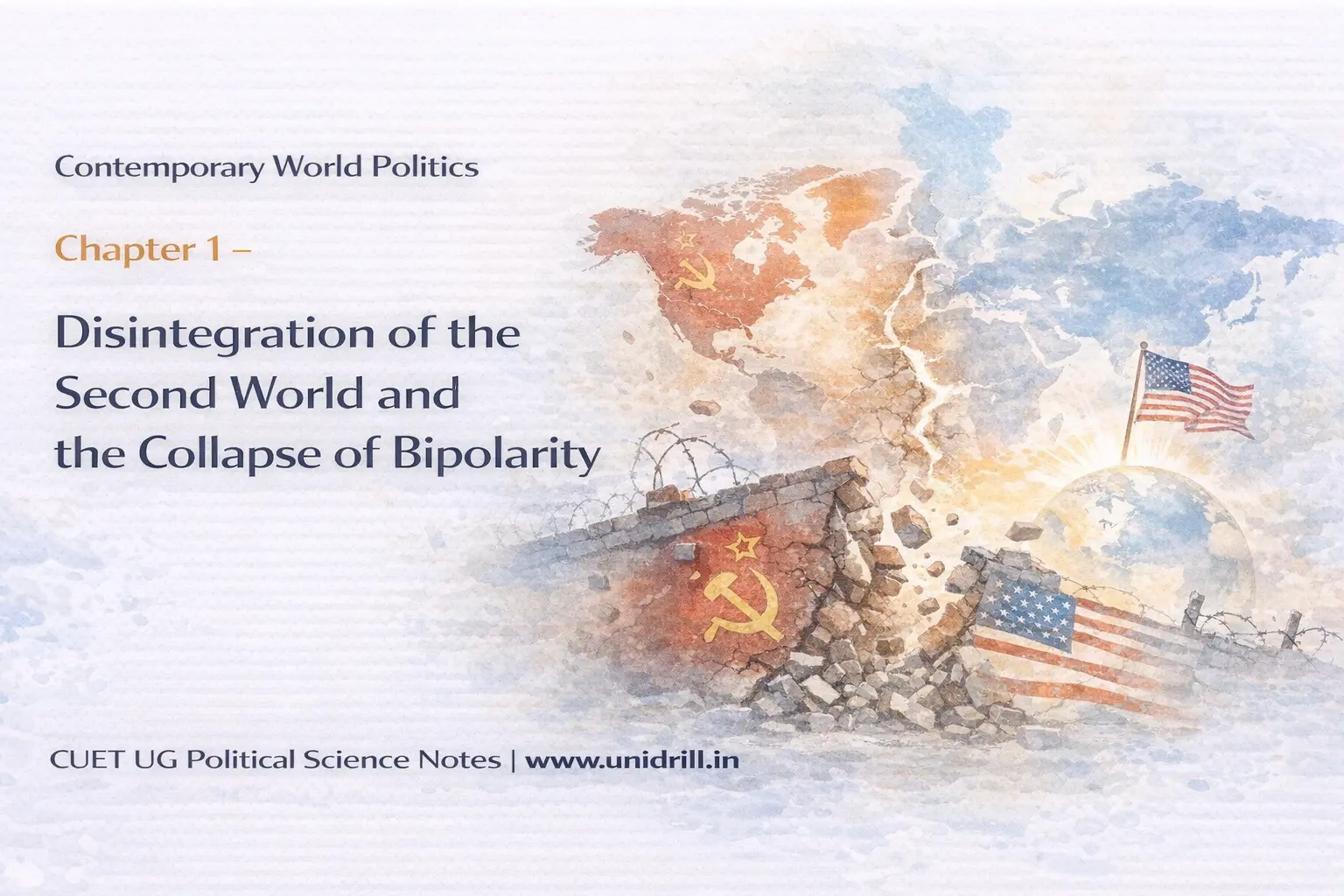
The fall of the Berlin Wall in 1989 symbolised the collapse of the Cold War division between capitalism and communism and initiated the disintegration of the socialist bloc.
The unification of Germany, democratic transformations in Eastern Europe, and the eventual breakup of the Soviet Union marked the end of the “second world.”
These developments occurred largely through mass political action rather than military conflict, making the end of the Cold War historically distinctive.
2. Nature and Structure of the Soviet System
The USSR emerged from the 1917 socialist revolution with the aim of abolishing private property and constructing an egalitarian society based on socialism.
Political power centred on a single-party communist system, with no scope for opposition or democratic accountability.
The economy was centrally planned and state-controlled, with state ownership dominating land, industry, and productive assets.
Despite authoritarianism, the system ensured minimum living standards, subsidised welfare, education, and healthcare, and developed strong industrial and communication networks.
However, bureaucratic rigidity, lack of freedom of expression, and domination of Russia over other republics created deep dissatisfaction.
3. Weakening of the Soviet Union
Economic stagnation, technological backwardness compared to the West, and excessive military expenditure strained the system.
Consumer shortages, rising food imports, and declining productivity revealed systemic inefficiencies.
The 1979 invasion of Afghanistan further weakened the USSR economically and politically.
4. Gorbachev’s Reforms and the Collapse
Mikhail Gorbachev introduced economic restructuring, political democratisation, and openness to modernise the USSR and improve relations with the West.
Reforms unintentionally encouraged protests in Eastern Europe and weakened central control.
The 1991 coup attempt by communist hardliners failed due to popular resistance led by Boris Yeltsin.
Power shifted to individual republics, culminating in the formal disintegration of the USSR in December 1991 and the adoption of capitalism and democracy in post-Soviet states.
Causes and Consequences of the Disintegration
1. Structural Causes of Collapse
Internal political and economic weaknesses prevented the system from meeting popular aspirations.
Long-term economic stagnation and heavy military spending imposed unsustainable burdens.
Growing awareness of Western prosperity created psychological and political disillusionment among Soviet citizens.
Administrative corruption, centralisation, privilege of party elites, and lack of accountability alienated the population.
2. Role of Reforms and Nationalism
Gorbachev’s reforms released forces that were difficult to control, dividing society between reformists and conservatives.
Rising nationalism and demands for sovereignty in republics such as Russia, the Baltic states, Ukraine, and Georgia became the immediate trigger of disintegration.
Contrary to expectations, nationalist unrest was strongest in relatively prosperous European regions rather than Central Asia.
3. Global Consequences of the Collapse
End of Cold War confrontation and ideological rivalry between socialism and capitalism.
Transformation of global power relations, leading initially to US unipolar dominance and the global spread of capitalism and liberal democracy.
Emergence of multiple new sovereign states with diverse political and economic trajectories.
4. Shock Therapy and Economic Transition
Post-communist countries adopted rapid transition to capitalism involving privatisation, free trade, deregulation, and openness to foreign investment.
Existing socialist trade networks were dismantled and replaced by integration with Western economic systems.
5. Consequences of Shock Therapy
Economic collapse in Russia and other states, including industrial decline, inflation, unemployment, poverty, and inequality.
Destruction of welfare systems, rise of oligarchic control and mafia networks, and weakening of democratic institutions.
Partial recovery after 2000 driven largely by export of natural resources such as oil and gas.
Regional Conflicts and India’s Relations with Post-Soviet States
1. Political Instability and Conflicts
Many former Soviet republics experienced civil wars, insurgencies, and secessionist movements, including Chechnya, Tajikistan, Georgia, and Nagorno-Karabakh.
External powers such as the US, Russia, and China competed for influence, especially in resource-rich Central Asia.
Violent ethnic conflicts also accompanied the breakup of Yugoslavia in Eastern Europe.
2. India’s Relations with Post-Communist Countries
India maintained cordial relations with all successor states, with Russia remaining the most significant partner.
The Indo-Russian relationship is rooted in historical trust, shared strategic interests, and cultural connections.
Both countries support a multipolar world order, collective security, negotiated conflict resolution, and strengthened international institutions.
3. Areas of Cooperation Between India and Russia
Defence cooperation and military technology sharing.
Energy security, including oil imports and investment in Central Asian resources.
Collaboration in nuclear energy, space technology, and scientific research.
Mutual political support on international issues such as terrorism and regional stability.
4. Continuing Significance of the End of Bipolarity
The disintegration of the Soviet Union reshaped global politics, economics, and regional alignments.
It demonstrated the limits of authoritarian socialism, the challenges of rapid capitalist transition, and the persistence of nationalism.
The post-Cold War world remains shaped by these transformations, particularly in the search for multipolar balance and stable international cooperation.