
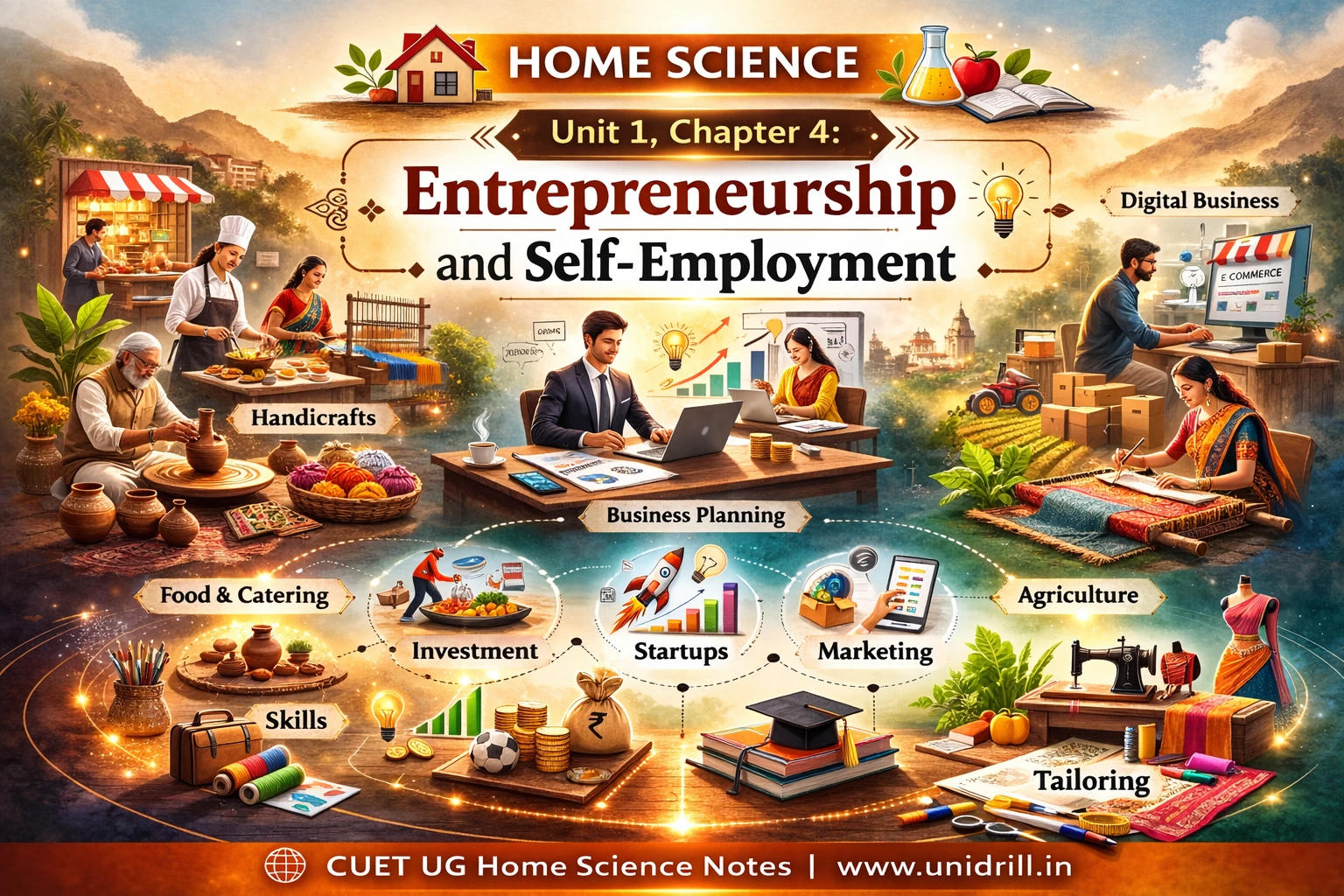
I. Introduction to the World of Work
In the transition from school to professional life, understanding the nature of work is essential.
Work is primarily an activity performed to fit into the world, create relations, utilize unique talents, and develop a sense of belonging to society.
While many view work as a job—conventionally understood as involvement for the sake of earning money to fulfill basic needs—others pursue a career, which is driven by a deep desire to excel and a passionate need to grow within a chosen field.
At the pinnacle of professional engagement lies entrepreneurship and self-employment, which offer challenging, stimulating, and highly rewarding avenues for building satisfying careers.
II. Understanding Entrepreneurship
Entrepreneurship is defined as the act of creating a new and innovative enterprise, product, or service.
It is not merely about starting a business but involves changing the pattern of production or product design through innovation, invention, or new technological methods.
The Entrepreneur: An entrepreneur is an individual who undertakes the creation of these changes. They are "engineers of change" and "champions of new processes" who use their acumen to assemble resources and finances to make a livelihood.
The Mindset: A true entrepreneur is characterized as innovative, creative, organized, and a risk-taker. They possess the vision to convert a novel idea into reality.
Scope of Activity: Entrepreneurial activities range from small individual projects or micro units, which may even be part-time, to major undertakings that provide employment to many people.
III. Core Characteristics of a Successful Entrepreneur
To achieve their objectives and handle the challenges of an enterprise, entrepreneurs must possess and hone specific personal attributes. These include:
Willingness to Work Hard: A fundamental requirement for the growth of any new venture.
Calculated Risk-Taking: Having the courage to take risks based on realistic assessments.
Management Skills: Proficiency in managing finances, materials, personnel, and time.
Multitasking: The ability and preparedness to handle many tasks simultaneously.
Problem-Solving Attitude: The ability to deal with tough issues and find solutions rather than expecting easy answers.
Flexibility and Resilience: Being able to handle crises and cope with set-backs, challenges, and failures.
Communication and Networking: The ability to develop partnerships, negotiate, and strategize through effective communication skills.
Lifelong Learning: A constant motivation to learn and acquire the necessary skills for the tasks at hand.
IV. Diverse Forms of Entrepreneurship
In the modern economic landscape, entrepreneurship is viewed as a specific mindset that can manifest in various forms.
Social Entrepreneurship: This focuses on achieving large-scale benefits for a specific underserved, neglected, or disadvantaged group or society at large. Social entrepreneurs act as "social catalysts" and visionaries who create sustainable improvements in fields like education, health care, and the environment. Their success is measured more by social impact than by profit.
Knowledge Entrepreneurship: A holistic conceptualization where the enterprise is driven by expertise and the application of knowledge.
V. Self-Employment and Entrepreneurial Avenues in HEFS
The field of Human Ecology and Family Sciences (HEFS) provides fertile ground for self-employment and entrepreneurial ventures across its various domains.
1. Food Processing and Technology: Historically, food processing in India was a household or cottage-scale activity producing items like pickles, papads, and murabbas. Today, this sector offers vast opportunities:
Ventures: One can start units ranging from low-investment dehydrated products or salted peanuts to technology-oriented, investment-intensive enterprises.
Specific Roles: Opportunities include starting analytical food laboratories, food safety consultancies, or businesses focused on Food Safety and Sanitation Education.
Product Development: Entrepreneurs can develop and supply specialty foods for specific health purposes.
2. Fabric, Apparel, and Fashion Design: This industry is a vibrant creative sector with high entrepreneurial potential.
Fashion Design: Designers can provide consistent looks for consumers while adapting current trends.
Merchandising: This involves the planning, buying, and selling of fashion apparel, offering prospects in retail and distribution.
Care and Maintenance: The establishment of commercial laundries or hi-tech laundry services for hospitals and the hospitality sector is a promising entrepreneurial area.
3. Resource Management and Hospitality: As the service sector grows, so do opportunities for personal enterprise.
Hospitality: Many companies now outsource hospitality-related activities, opening doors for entrepreneurial ventures.
Housekeeping: Starting a housekeeping consultancy or providing services on a contractual basis to corporate offices is a gigantic but rewarding task.
Event Management: This has become a specialty profession involving the planning of product launches, weddings, and government schemes.
Interior and Landscape Design: Professionals can set up private practices to design user-friendly indoor and outdoor spaces.
4. Early Childhood Care and Education (ECCE): A person trained in ECCE can set up their own child care and education-related programme, either at home or in a dedicated space.
Enterprises: These can include activity clubs, preschool education centres, or "edu-picnics" and camps for young children. This requires expertise in both education and the management/organization of such institutions.
5. Consumer Education and Protection:
Consultancy: One can start a consumer organization or work as a freelance consultant for redressal guidance through consumer courts.
Advocacy: Creating content for consumer awareness advertisements in print and electronic media.
VI. Exemplars of Entrepreneurial Success
India has produced numerous visionary entrepreneurs who serve as models for the youth.
Eminent Leaders: Notable figures include Mr. Narayan Murthy, JRD Tata, and Dhirubhai Ambani.
Kiran Mazumdar Shaw: A biotechnologist who started as a trainee brewer and formed Biocon India Ltd. in 1978. Under her leadership, Biocon transformed into a pioneering integrated biopharmaceutical company, earning her prestigious awards like Best Woman Entrepreneur.
Shri Mahila Griha Udyog Lijjat Papad: This organization is a prime example of an "organized effort for empowerment of women". Started in 1959 by seven women, it provides self-employment to approximately 45,000 members today. Paving the way for women to become self-reliant, it operates as a recognized "village industry" with a multi-crore annual turnover.
VII. Essential Life Skills for Career Building
Building a career, whether as an employee or an entrepreneur, requires the honing of life skills—defined by the World Health Organisation as thinking, coping, and social skills.
Essential Soft Skills:
Working Productively: Applying effective work habits and dynamism.
Learning Effectively: Acquiring skills in reading, writing, computing, and information technology.
Communicating Clearly: Applying appropriate writing, speaking, and listening skills to convey ideas precisely.
Working Cooperatively: Completing tasks with others and resolving conflicts.
Thinking Critically and Creatively: Using analytical thinking and innovation to make an impact.
Effective Decision-Making: Prioritizing factors and anticipating outcomes in the best interest of the enterprise.
Flexibility and Adaptability: The ability to positively adapt to societal and environmental changes.
VIII. Government Initiatives and Support Systems
The Government of India recognizes that national progress depends on nurturing youth as a positive force for growth.
Institutional Support: Aspiring entrepreneurs can seek help from government agencies, scientific institutes, and financial institutions like banks.
Financial Incentives: Banks provide financial support, with specific encouragement and space allocation for women entrepreneurs.
Training Schemes:
National Service Volunteer Scheme: Provides degree-holders with opportunities to involve themselves in national development through Nehru Yuva Kendras.
Livelihood Schemes: Various self-employment and wage-employment schemes act as social safety nets.
Intellectual Property: There is an increasing focus on protecting Intellectual Property Rights (IPR) to safeguard indigenous knowledge and design innovations.