
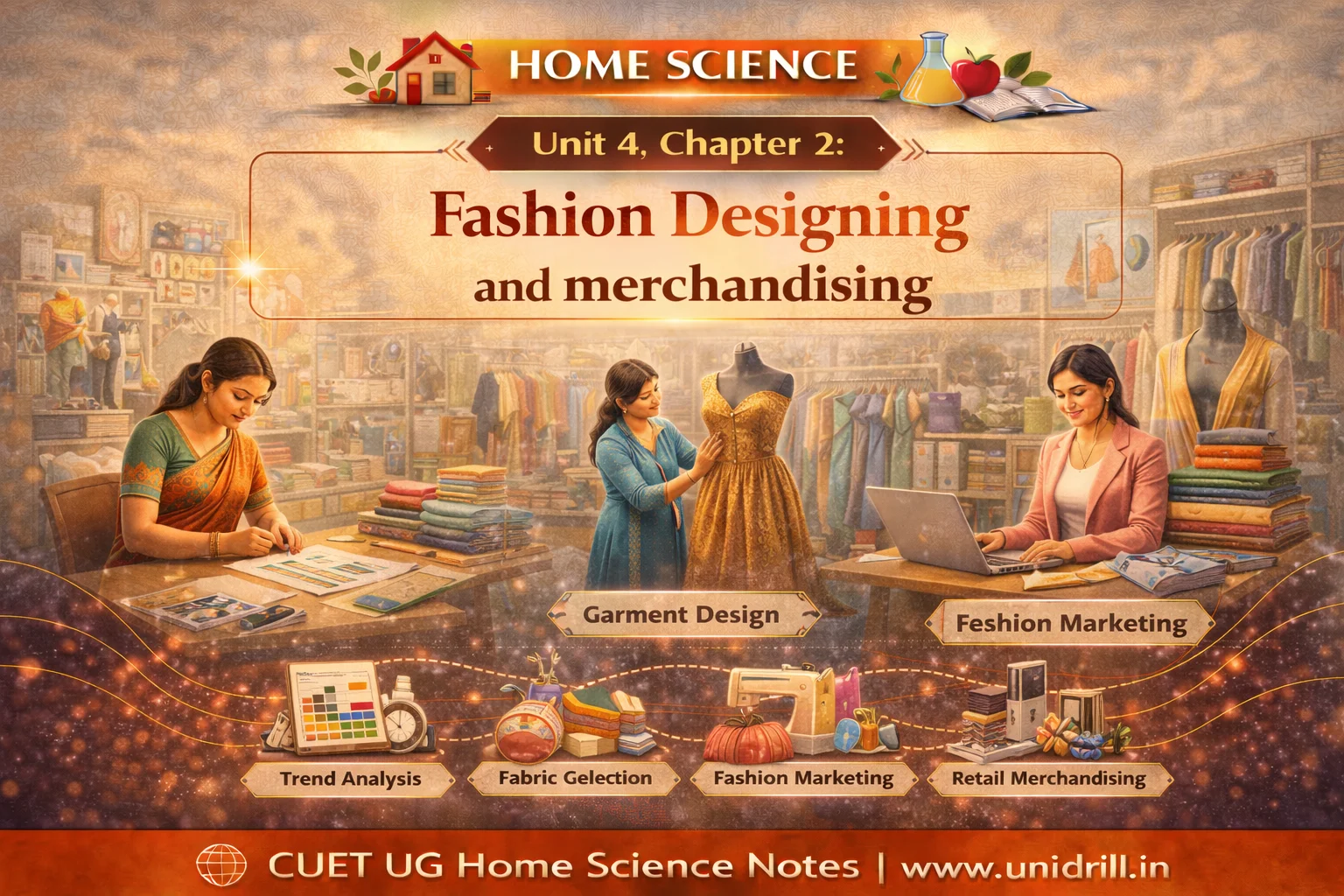
I. Introduction to Fashion and Design
Fashion design and merchandising represent some of the most exciting and dynamic career options in the modern world.
In India, these fields have gained significant prospects due to a long-standing textile industry and a recent boom in garment and accessory design.
The fashion industry is unique in that it satisfies both the creative urge and the materialistic needs of people.
While often associated with high fashion and accessories, design in its broadest sense is the human power to conceive, plan, and realise products that serve specific individual or collective purposes.
A successful design must be more than just aesthetically pleasing; it must be functional and appropriate for its intended usage.
II. Basic Concepts of Design Analysis
Design is studied through two primary aspects:
Structural Design: This depends on the basic form or silhouette of the object rather than superimposed ornamentation. In fabric production, it includes the processing of fibres, yarn types, and variations in weaving or knitting. In apparel, it refers to the basic cut of the garment.
Applied Design: This is the part of the design superimposed on the basic structure. On fabrics, this includes finishes, dyeing, printing, and embroidery. On garments, it includes trims and notions (fasteners) that add value to the final product.
III. The Elements of Design (The Tools of Art)
Elements are the basic components manipulated to create a plan or pattern.
1. Colour Colour is one of the most vital aspects of textile materials, as a product's identity is often attributed to it.
Dimensions of Colour: Reference is often made to the Munsell’s Colour Wheel, which specifies colour in three aspects: Hue (the common name of the colour), Value (lightness or darkness), and Intensity or Chroma (brightness or purity).
Classification: Colours are divided into Primary (red, yellow, blue), Secondary (orange, green, violet), and Tertiary/Intermediate. Neutral colours include black, white, grey, silver, and metallics.
Colour in Fabric: Colour can be added at the fibre stage (rare and expensive), yarn stage (for stripes, checks, or Ikat), or most commonly at the fabric stage through solid dyeing, tie and dye, or batik. It can also be applied via painting, printing, or appliqué.
International Standards: To facilitate global trade, the Pantone Shade Card provides internationally recognised code numbers for all possible hues and intensities.
2. Texture Texture refers to the visual and tactile qualities of a material—how it looks, feels, and behaves.
Visual qualities include shiny, dull, opaque, or transparent.
Feel includes soft, crisp, smooth, or grainy.
Factors determining texture include fibre content (length and fineness), yarn processing (twist), fabric construction (weaving, knitting, felting), finishes (starching, napping), and surface ornamentation (tufting, flock printing).
3. Line and Shape Line connects two points and is used to define the shape or silhouette of a design. Line and shape together create the pattern of every design.
Shape and form in fabric refer to the drape and placement of motifs, while in apparel, they represent the silhouette, cut, and detailing.
Patterns are formed when these shapes are grouped in natural, stylised, geometric, or abstract arrangements.
IV. The Principles of Design (The Rules of Art)
Principles govern how the elements are mixed to produce an appealing product.
Proportion: This concerns the relationship of one part of an object to another. It is often based on the Golden Mean, represented by ratios such as 3:5:8 or 5:8:13. For example, a dress is aesthetically pleasing if the blouse represents 3, the skirt 5, and the total body 8. Proportion can also be applied to colour and texture to modify body figures.
Balance: This is the equal distribution of weight from the central point of the garment. Formal balance (symmetrical) provides stability and dignity but can be monotonous. Informal balance is often used to correct figure problems through various design elements.
Emphasis: Also known as the focal point, this is the area that first attracts the eye. Details focusing on the face are particularly effective in many cultures.
Rhythm: This is the repetition of elements to create a pattern by which the eye flows through the garment. It can be achieved through repetition of buttons/laces, gradation (gradual size changes), radiation (movement from a central point), or parallelism (tucks or pleats).
Harmony: Also called unity, this is created when all elements come together for a pleasing effect, which is critical for producing marketable designs.
V. Fashion Terminology and Development
Fashion: The style or styles most popular at a given time.
Style: A particular look or characteristic in apparel; while styles remain, they may go in and out of fashion.
Fads: Short-lived fashions that lack the design strength to hold attention for long (e.g., hot pants).
Classic: Timeless styles that never become completely obsolete (e.g., blazer jackets, Chanel suit).
Fashion History: France became the international centre of fashion in the early 18th century, supported by the royal court and a thriving silk industry.
The term Couture refers to the art of dressmaking, with a male designer called a couturier. The Industrial Revolution introduced technological advances like the spinning jenny and power looms, which increased fabric production.
In 1849, Levi Strauss used tent fabric to create durable pants for labourers, known today as denims.
By the 1880s, separate skirts and blouses were introduced, marking a step toward ready-to-wear clothes for women.
The Fashion Cycle: Fashion moves in a cycle represented by a bell-shaped curve. The stages include:
Introduction: Designers offer new styles to the public.
Increase in Popularity: New fashions are purchased and worn by more people.
Peak of Popularity: Fashions are mass-produced or adapted at various price levels.
Decline: Consumers tire of the style, and it is placed on sale racks.
Rejection or Obsolescence: Consumers turn to new looks, beginning a new cycle.
VI. Fashion Merchandising
Fashion merchandising involves the planning required to have the right merchandise, at the right time, in the right place, at the right price, and with the right promotion.
A fashion merchandiser facilitates the conversion of inspiration into design and uses technology to handle planning, production, and distribution.
Roles of the Merchandiser:
In Manufacturing: Inputting on fabric types and finding the best way to manufacture an item based on price and target market.
In Buying: Ordering items for a store based on trend analysis and forecasting.
In Promoting: Organising fashion shows and identifying the target market.
In Selling: Providing recommendations on production and suggests how to display items in retail settings.
Levels of Merchandising:
Retail Organisation Merchandising: Moving fashion from the showroom to the retail floor for consumers.
Buying Agency Merchandising: Acting as a procurement office for buyers, identifying vendors, and negotiating costs.
Export House Merchandising: Includes buyer merchandisers (sourcing and communication) and production merchandisers (ensuring schedules are met).
VII. Target Markets and Business Structures
To ensure high returns, the industry focuses on a Target Market through Market Segmentation. Segmentation includes:
Demographic: Based on age, sex, occupation, and income.
Geographic: Based on regions and climate.
Psychographic: Based on lifestyle and interests.
Behavioural: Based on opinions of specific products.
Retail Business Types:
Small Single-unit Store: Neighbourhood, owner-operated stores.
Department Stores: Feature separate sections for different products (clothing, electronics, etc.).
Chain Stores: Multiple outlets sharing a brand and central management.
VIII. Preparing for a Career
Success in this field requires a blend of style and business sense. Three primary skills are essential:
Forecasting Ability: Knowing past and future trends to capitalise on them in time.
Analytical Ability: Analysing the "dollars and sense" of the job, including the broader economy and consumer budgets.
Communication Ability: Negotiating prices with manufacturers and selling choices to the public through advertising and press releases.
Educational Pathways: Courses are offered as diplomas (6 months to 1 year), 2-year Master’s programmes, or 4-year Bachelor’s degrees that combine liberal arts with fashion and business courses.
Specialised courses are available in institutes like Polytechnics and Art and Design Institutes.
IX. Scope and Career Avenues
The fashion industry offers lucrative income and high entrepreneurial potential; about one-third of professional fashion designers are self-employed. Popular Careers include:
Visual Merchandise Designers: Responsible for window displays and store arrangements.
Fashion Designers: Creating designs for clothing and apparel or managing independent labels.
Other Roles: Interior designing, merchandise displays, theater set design, and costume design.