
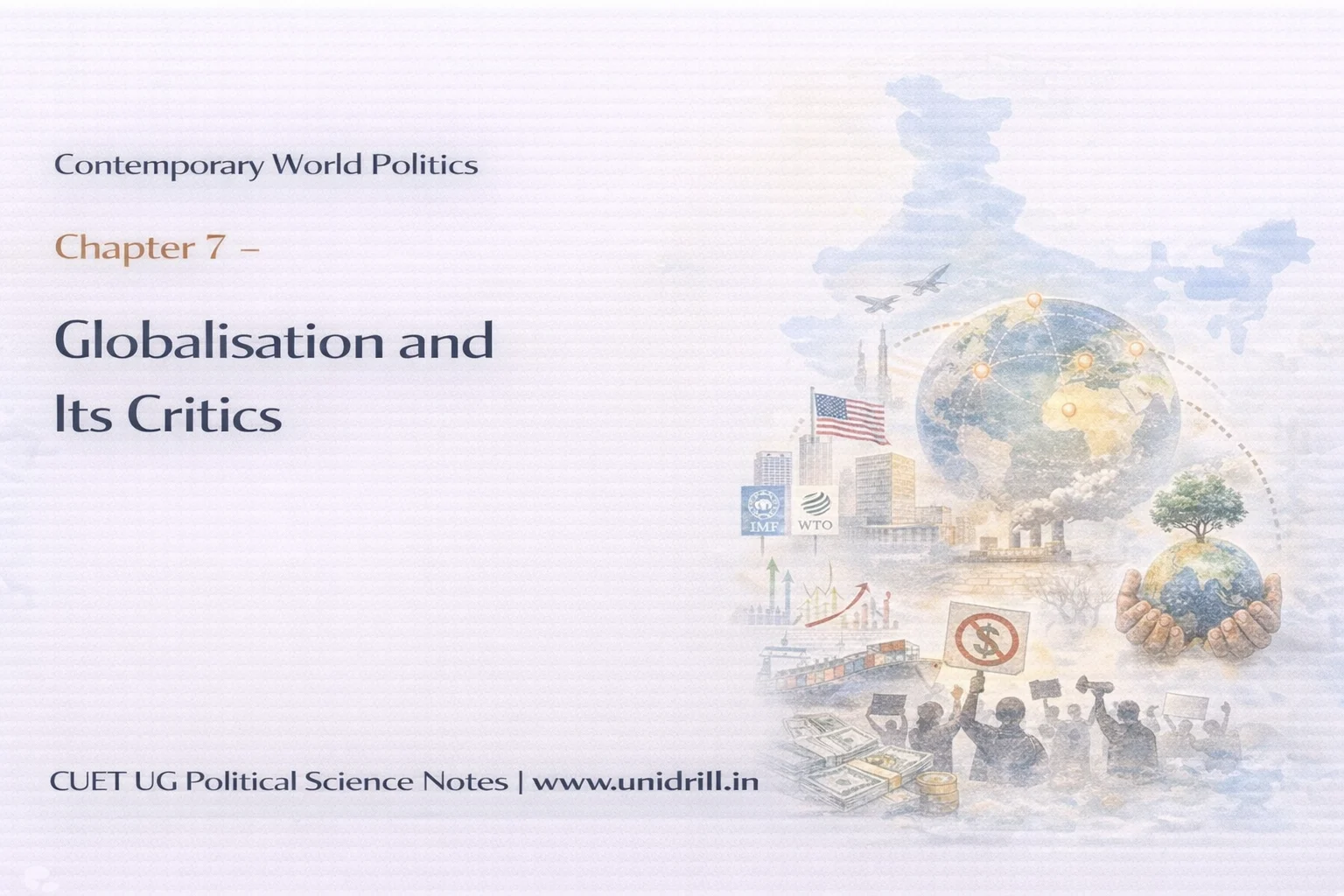
The Concept and Causes of Globalisation
I. Introduction: Understanding Globalisation
Introduce globalisation as a widely used but often imprecise concept.
Refer to everyday illustrations (call centres, imported goods, new opportunities for women) to show how globalisation penetrates daily life.
Emphasise: globalisation is not confined to economics; it affects work patterns, consumption, identity, and values.
Highlight that globalisation may generate both positive and negative consequences.
Core Definition: Globalisation fundamentally deals with flows:
Ideas
Capital
Commodities
People
The crucial element is “worldwide interconnectedness” created and sustained by these constant flows.
II. Globalisation as a Multi-Dimensional Concept
Globalisation has three major manifestations:
1. Political Dimension
Challenges traditional conceptions of sovereignty.
Alters state capacity and decision-making autonomy.
2. Economic Dimension
Greater trade and capital flows.
Role of institutions like IMF and WTO.
Debate over distribution of gains.
3. Cultural Dimension
Impact on lifestyle, food, clothing, media.
Fear of cultural homogenisation.
⚠ Important analytical caution:
Globalisation is neither purely economic nor purely cultural.
It affects societies unevenly.
Avoid sweeping generalisations; context matters.
III. Historical Context of Globalisation
Global flows are not entirely new.
Movement of ideas, goods, and people existed historically.
What distinguishes contemporary globalisation:
Scale
Speed
Intensity
Globalisation today must be viewed against its historical backdrop.
IV. Causes of Globalisation
A. Technology as a Critical Factor
Telegraph, telephone, microchip revolutionised communication.
Printing earlier helped create nationalism; modern technology reshapes global consciousness.
Internet accelerates idea flows.
Capital and commodities move faster than people.
Key Insight: Technology enables globalisation but does not automatically create it.
B. Awareness and Recognition of Interconnectedness
People recognise that events in one part of the world affect others.
Examples:
Bird flu
Tsunami
Economic crises
Globalisation emerges when societies acknowledge these interconnections.
C. Differential Mobility of Flows
Capital and commodities move more freely.
Movement of people remains restricted.
Developed countries protect labour markets via visa regimes.
This asymmetry shapes global inequalities.
V. Concluding Analytical Reflection (Page 1)
Globalisation is complex and layered.
Driven by technology, awareness, and expanding flows.
Produces uneven effects.
Requires contextual and critical understanding rather than ideological reaction.
Political and Economic Consequences of Globalisation
I. Political Consequences
Central Question: How does globalisation affect state sovereignty?
There are three major aspects:
A. Erosion of State Capacity
Shift from welfare state to minimalist state.
State withdraws from welfare functions.
Market becomes prime determinant of social priorities.
Increased role of multinational companies.
Reduced autonomy in economic decision-making.
This suggests weakening of sovereignty.
B. Persistence and Primacy of the State
However:
State remains basis of political community.
National rivalries continue.
Core functions remain intact:
Law and order
National security
State withdraws selectively, not entirely.
C. Strengthening of State Power Through Technology
Enhanced surveillance capacity.
Information gathering through technology.
States may become stronger, not weaker.
Thus, globalisation produces a paradoxical effect:
Simultaneous erosion and reinforcement of state power.
II. Economic Consequences
Economic globalisation generates intense debate.
A. Meaning of Economic Globalisation
Greater economic flows among countries.
Trade liberalisation.
Reduced import restrictions.
Capital mobility.
Foreign investments.
Institutions:
IMF
WTO
But economic globalisation involves more than these institutions.
B. Uneven Distribution of Gains
Critical issue: Who benefits? Who loses?
Developed vs developing countries.
Rich vs poor within countries.
Globalisation generates vastly different outcomes in different contexts.
C. Critics of Economic Globalisation
Concerns:
State withdrawal harms poor.
Reduction in welfare spending.
Weak sections suffer.
Demand for “social safety nets.”
Some describe it as re-colonisation.
Forced liberalisation harms weaker countries.
D. Advocates of Economic Globalisation
Arguments:
Greater trade leads to efficiency.
Each economy does what it does best.
Generates growth and well-being.
Considered historically inevitable.
Moderate view:
Globalisation should be engaged intelligently, not uncritically rejected.
III. Core Economic Insight
Despite disagreements:
There is undeniable increased interdependence among:
Governments
Businesses
Ordinary people
This interdependence is the defining feature of contemporary globalisation.
IV. Concluding Analytical Reflection (Page 2)
Political and economic globalisation:
Weakens some aspects of state power.
Strengthens others.
Generates growth but unevenly.
Produces both integration and inequality.
Remains deeply contested.
Cultural Consequences, India and Globalisation, and Resistance
I. Cultural Consequences of Globalisation
Globalisation shapes:
Food habits
Clothing
Media consumption
Thought patterns
Identity
A. Cultural Homogenisation
Fear of uniform culture.
Imposition of Western (especially American) culture.
“Soft power” of US hegemony.
McDonaldisation.
Dominant culture influencing weaker societies.
Concern: Shrinking of global cultural diversity.
B. Cultural Heterogenisation
However:
Cultures are not static.
External influences may enlarge choices.
Hybrid combinations emerge:
Jeans with khadi kurta.
Cultural borrowing in multiple directions.
Cultural exchange is rarely one-way.
Thus, globalisation produces both:
Homogenisation
Differentiation
II. India and Globalisation
A. Historical Experience
Colonial period:
Exporter of raw materials.
Importer of finished goods.
Post-independence:
Protectionism.
Self-reliance.
Restricted imports.
State-led development.
Sluggish growth.
B. Economic Reforms of 1991
Financial crisis.
Desire for higher growth.
De-regulation.
Liberalisation of trade and foreign investment.
Key evaluation criterion: Not just growth rates, but equitable distribution of benefits.
C. India’s Role in Globalisation
Call centres and services.
IT sector.
Integration into global markets.
Cultural exports.
India both experiences and shapes globalisation.
III. Resistance to Globalisation
Globalisation is highly contentious.
A. Left-Wing Critique
Makes rich richer, poor poorer.
Weakens state capacity.
Leads to economic disparity.
Viewed as imperialism or re-colonisation.
B. Right-Wing Critique
Fear of cultural erosion.
Demand for protectionism.
Concern over traditional values.
Opposition to westernisation.
C. Global Anti-Globalisation Movements
1999 Seattle WTO protests.
World Social Forum (from 2001 onwards).
Global networks of resistance.
Interestingly: Resistance movements also use global networks.
D. Resistance in India
Political parties.
Indian Social Forum.
Trade unions.
Farmers’ protests.
Opposition to multinational entry.
Cultural resistance (foreign TV channels, Valentine’s Day).
Resistance comes from multiple ideological positions.
IV. Concluding Analytical Reflection (Final Page)
Globalisation is:
Multi-dimensional.
Uneven.
Contested.
Historically rooted.
Technologically accelerated.
It produces:
Integration and inequality.
Homogenisation and heterogeneity.
Weakening and strengthening of the state.
Opportunity and anxiety.
Final Evaluative Position (in textbook spirit):
Globalisation should neither be:
Uncritically celebrated, nor
Entirely rejected.