
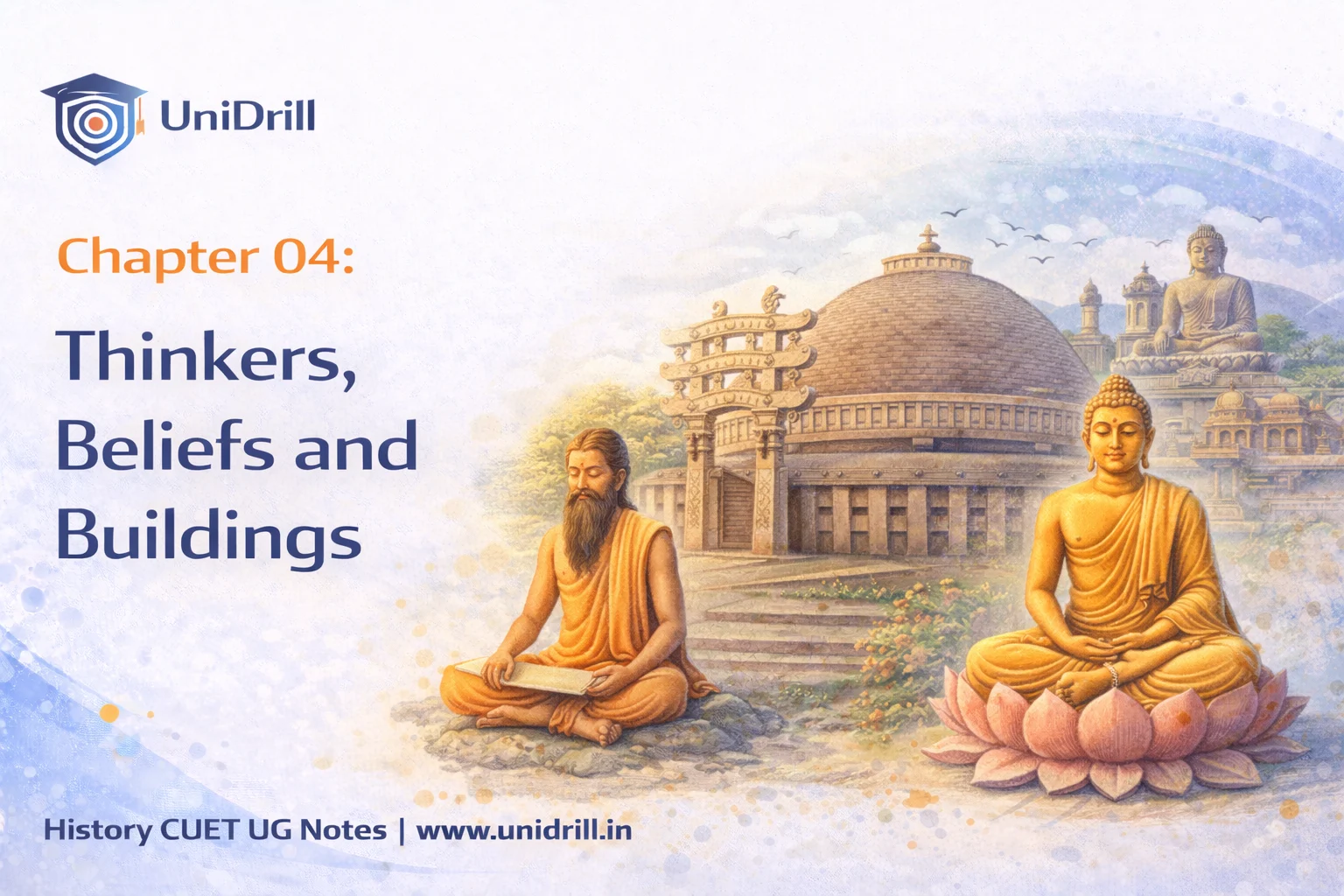
Intellectual Background, Debates, and Early Traditions
The period between c. 600 BCE and 600 CE marks a significant phase in the cultural and intellectual history of the Indian subcontinent.
It was a time when thinkers attempted to understand the world they inhabited, raising fundamental questions about existence, the nature of reality, and human life. These ideas were not only preserved in oral and written texts but were also expressed through architecture and sculpture.
Importantly, these traditions did not develop in isolation; rather, they evolved through continuous dialogue and debate among diverse schools of thought. Historians reconstruct this complex intellectual world through sources such as Buddhist, Jaina and Brahmanical texts, along with material remains including monuments, inscriptions and sculptures
This intellectual ferment must be understood against the background of broader social and economic changes. The mid-first millennium BCE is often regarded as a turning point in world history, witnessing the emergence of major thinkers across different regions.
In the Indian context, figures such as Mahavira and Gautama Buddha engaged deeply with the changing conditions of the Ganga valley, where new kingdoms and cities were emerging.
These transformations encouraged reflection on social structures, moral values and the purpose of life.
Before the rise of these new traditions, religious practices were largely shaped by the Vedic sacrificial tradition. The Rigveda, compiled between c. 1500 and 1000 BCE, contains hymns dedicated to various deities such as Agni, Indra and Soma.
These hymns were recited during sacrifices performed to secure material benefits like cattle, sons, good health and long life.
Over time, sacrificial practices evolved. Initially performed collectively, they later became household rituals and, eventually, elaborate ceremonies such as the rajasuya and ashvamedha conducted by kings with the assistance of Brahmana priests. This increasing ritual complexity also reinforced the authority of the priestly class.
However, by around the sixth century BCE, new questions began to emerge. The Upanishads reflect a growing curiosity about deeper philosophical issues such as the nature of the self (atman), the possibility of life after death, and the role of karma in determining rebirth.
Thinkers debated whether there was a single ultimate reality and whether the sacrificial tradition truly held significance. These questions marked a shift from ritualistic practices to philosophical inquiry.
Debates and discussions became a prominent feature of this intellectual landscape. Buddhist texts mention as many as 64 schools of thought, indicating the diversity of ideas prevalent at the time.
Teachers travelled from place to place, engaging in debates with one another and attempting to convince audiences of their views.
These discussions often took place in kutagarashalas or groves where travelling mendicants stayed. Success in debate could lead to the conversion of followers, demonstrating the dynamic and competitive nature of these traditions.
Several thinkers, including Mahavira and the Buddha, questioned the authority of the Vedas and emphasised individual agency.
They argued that liberation from worldly suffering could be achieved through personal effort rather than through rituals determined by birth or caste. This stood in contrast to the Brahmanical view, which linked an individual’s status and duties to their social position.
Alongside these traditions were others such as the Ajivikas and Lokayatas. The Ajivikas are often described as fatalists who believed that everything was predetermined and that human effort had little significance.
In contrast, the Lokayatas or materialists rejected the existence of an afterlife and dismissed rituals and sacrifices as meaningless.
Since texts from these traditions have not survived, our understanding of them comes largely from the writings of their critics, which poses challenges for historians attempting to reconstruct their ideas.
The teachings of the Buddha, like those of many other thinkers, were initially transmitted orally. After his death, they were compiled by his disciples into the Tipitaka, consisting of the Vinaya Pitaka (rules for the monastic order), the Sutta Pitaka (teachings) and the Abhidhamma Pitaka (philosophical discussions).
These texts were preserved and transmitted across regions, illustrating the enduring influence of these ideas.
Jainism and Buddhism – Doctrines, Practices, and Social Appeal
Jainism represents one of the most important religious traditions of this period. Its basic philosophy predated Mahavira, who is regarded as the 24th tirthankara, or spiritual teacher.
A central belief in Jainism is that the entire world is animated, meaning that even stones, water and plants possess life. This belief underpins the principle of ahimsa or non-violence, which is considered the cornerstone of Jaina ethics.
According to Jain teachings, the cycle of birth and rebirth is determined by karma, and liberation can only be achieved through strict ascetic practices and renunciation of worldly attachments.
Monastic life was therefore essential in Jainism. Monks and nuns were required to follow five vows: abstaining from killing, stealing and lying, observing celibacy, and renouncing possessions.
These principles emphasised discipline and self-control as means to attain spiritual liberation. Over time, Jainism spread to various parts of the subcontinent, and its followers contributed significantly to literature in languages such as Prakrit, Sanskrit and Tamil.
Early stone sculptures of tirthankaras found at different sites also indicate the material expression of Jaina beliefs.
Parallel to Jainism, Buddhism emerged as a powerful and influential tradition. According to tradition, Siddhartha, later known as the Buddha, was born into a ruling family and led a sheltered life within the palace. His encounters with an old man, a sick person and a corpse profoundly affected him, making him aware of the inevitability of suffering. Seeing a mendicant who had renounced the world inspired him to seek a solution to human suffering.
He left his home and pursued various paths, including extreme asceticism, before ultimately attaining enlightenment through meditation. Thereafter, he became known as the Buddha, or the Enlightened One.
The Buddha’s teachings, preserved mainly in the Sutta Pitaka, emphasised rational understanding and ethical conduct. He taught that the world is transient (anicca), without a permanent self (anatta), and inherently characterised by suffering (dukkha).
To overcome this suffering, he advocated the middle path, which avoids both excessive indulgence and extreme asceticism. Unlike many other traditions, Buddhism did not focus on the existence of a creator god; instead, it emphasised individual effort and moral discipline.
The Buddha also offered a distinct perspective on society. He viewed social arrangements as human creations rather than divinely ordained structures. Consequently, he encouraged rulers and householders to act ethically and compassionately.
Liberation, or nibbana, was seen as the result of extinguishing desire and ego through self-effort. His famous exhortation to his followers to “be lamps unto yourselves” highlights the emphasis on personal responsibility.
A significant aspect of Buddhism was the formation of the sangha, or monastic community. This organisation included monks (bhikkhus) and, later, nuns (bhikkhunis). Members of the sangha lived simple lives, relying on alms for sustenance.
The sangha functioned democratically, with decisions made through discussion and voting. Importantly, it was open to people from all social backgrounds, including kings, merchants, workers and even slaves. Women were also admitted, reflecting a degree of inclusivity unusual for the time.
The popularity of Buddhism can be attributed to several factors. Its rejection of rigid social hierarchies, emphasis on ethical conduct rather than birth, and accessible teachings made it appealing to a wide range of people. Concepts such as compassion (karuna) and fellow-feeling (metta) resonated strongly with those experiencing the social changes of the period.
Stupas, Art, and Changing Religious Traditions
Buddhist ideas were not only expressed through texts but also through architectural and artistic forms, most notably stupas. These structures originated as simple burial mounds but came to be associated with Buddhism as repositories of the Buddha’s relics.
Over time, stupas became sacred symbols representing both the Buddha and his teachings. Sites associated with key events in the Buddha’s life—such as Lumbini, Bodh Gaya, Sarnath and Kusinagara—were also regarded as sacred.
The construction of stupas involved contributions from a wide range of patrons. Inscriptions on railings and pillars reveal donations made by kings, guilds, monks, nuns and ordinary individuals, including women.
These inscriptions often mention the donor’s name, occupation and place of origin, highlighting the collective nature of these religious activities.
Architecturally, the stupa evolved into a complex structure. The central mound or anda symbolised the burial site, while the harmika represented the abode of the gods. The yashti, a central mast, and the chhatri, an umbrella-like structure, added symbolic significance.
A railing surrounded the stupa, separating the sacred space from the secular world. Devotees performed pradakshina, or circumambulation, moving clockwise around the stupa as an act of worship.
The histories of stupas such as those at Sanchi and Amaravati also reveal the processes of discovery and preservation.
While Amaravati suffered from neglect and the removal of its sculptures, Sanchi survived largely intact due to timely recognition of its importance and efforts to preserve it. This contrast highlights the role of historical awareness and conservation practices.
Sculptures at these sites provide valuable insights into religious and cultural life. Many depict stories from the Jatakas, illustrating the previous lives of the Buddha. Early representations of the Buddha were symbolic rather than anthropomorphic, using images such as the empty seat, the Bodhi tree and the wheel to signify his presence and teachings. These symbols required viewers to be familiar with the associated narratives.
At the same time, popular traditions influenced Buddhist art. Figures such as the shalabhanjika, a woman associated with fertility, and depictions of animals suggest the integration of pre-existing beliefs into Buddhist practices.
Paintings, particularly those at Ajanta, further demonstrate the richness of visual culture, depicting scenes of daily life, courtly activities and religious narratives with remarkable detail and realism.
By the first century CE, significant changes began to occur within Buddhism. The Mahayana tradition emerged, introducing the idea of the Buddha as a saviour figure and emphasising the role of Bodhisattvas—compassionate beings who sought to help others attain liberation.
This marked a shift from earlier emphasis on individual effort to a greater focus on devotion and collective salvation.
Simultaneously, developments within what later came to be known as Hinduism led to the growth of Puranic traditions. These included Vaishnavism and Shaivism, which emphasised devotion (bhakti) to a personal deity.
The concept of avatars, particularly in Vaishnavism, reflected the belief that divine beings intervened in the world to restore order. The Puranas, composed in accessible Sanskrit, played a crucial role in disseminating these ideas among a wider audience.