
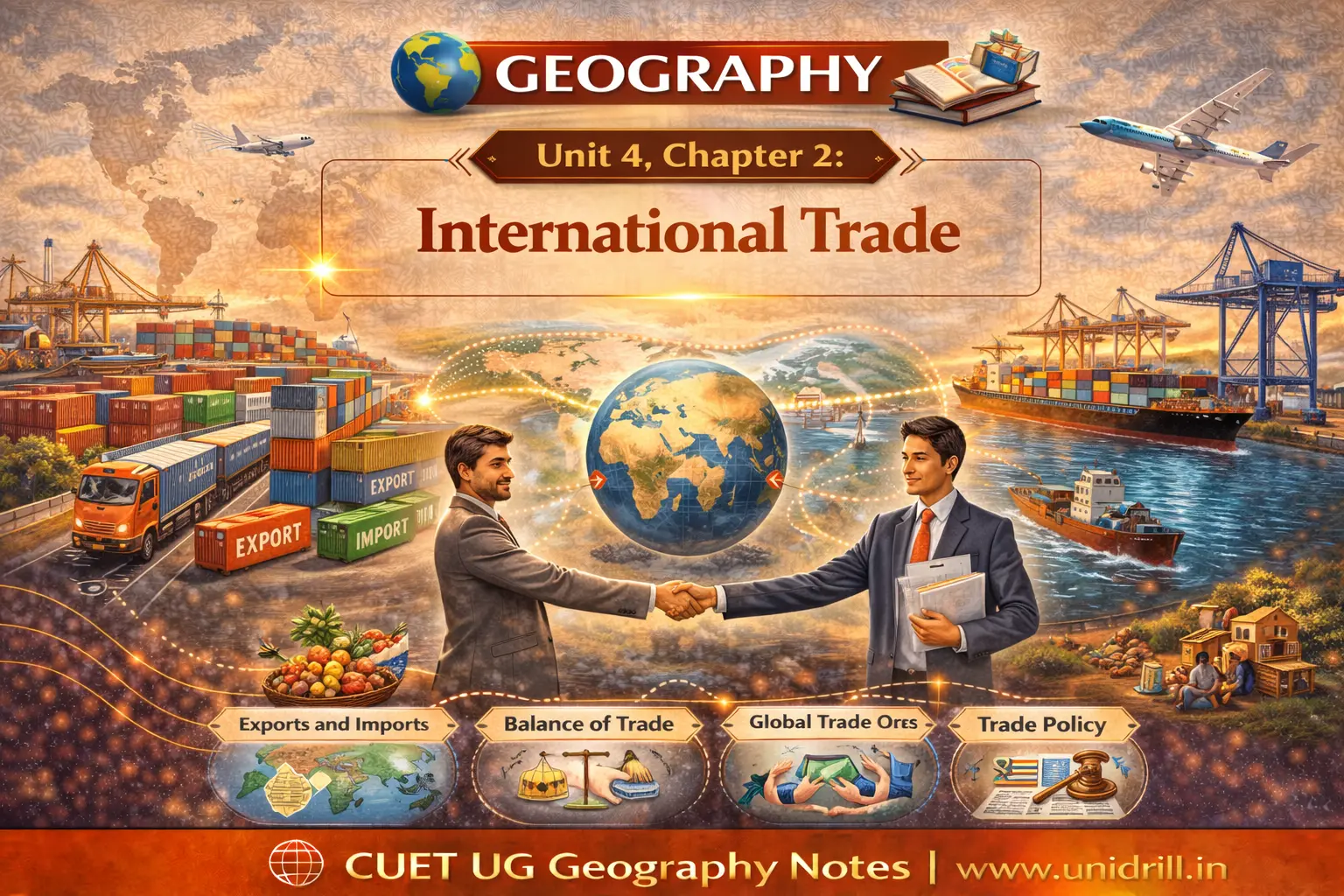
1. Fundamentals of International Trade
International trade is defined as the voluntary exchange of goods and services between countries across national boundaries.
Unlike national trade, it exists because no country is completely self-sufficient; nations need to obtain commodities they cannot produce themselves or purchase them elsewhere at a lower price.
I. Historical Evolution
Ancient Times: Trade was primarily local due to the risks of long-distance transport. Luxury items (gems, silk, spices) were the only goods traded over long distances for the wealthy.
The Silk Route: An early 6,000 km long-distance trade link connecting Rome to China, transporting Chinese silk, Roman wool, and precious metals.
Colonialism and Slave Trade: From the 15th century, European colonialism led to the "Slave Trade," where Portuguese, Dutch, and British traders captured and forcefully transported African natives to the Americas.
Industrial Revolution: The 18th-century shift to power-driven machinery changed trade dynamics. Industrialised nations imported raw materials (grains, wool, meat) and exported value-added finished products back to non-industrialised regions.
Modern Era: In the late 19th century, industrial nations became each other's principal customers. Post-World War II, organisations like GATT (and later WTO) were formed to reduce trade taxes and restrictions.
II. The Principle of Comparative Advantage
International trade is the result of specialisation in production. It is based on the principle of comparative advantage, complementarity, and transferability of goods.
If different countries specialise in specific commodities or services, the world economy benefits through increased efficiency and mutually beneficial partnerships.
2. The Basis of International Trade
Several factors determine why and how countries trade with one another:
Differences in National Resources: Resources are unevenly distributed due to variations in geology, relief, soil, and climate.
Geological Structure: Determines the mineral resource base (e.g., fuel minerals vs. metallic minerals).
Climate: Influences the types of flora and fauna (e.g., wool production in cold regions, cocoa/rubber in tropical areas).
Population Factors:
Cultural Factors: Distinctive arts and crafts (e.g., Chinese porcelain, Iranian carpets, Indonesian batik) create global demand for prized handicrafts.
Size and Standard of Living: Densely populated countries often have large internal trade but limited external trade because production is consumed locally. A higher standard of living increases the demand for quality imported goods.
Stage of Economic Development: Agriculturally based nations exchange agro-products for manufactured goods, while industrialised nations export machinery and import food grains and raw materials.
Extent of Foreign Investment: This can boost trade in developing nations that lack capital for intensive industries like mining, oil drilling, or plantation agriculture.
Transport: Historically, trade was restricted by lack of transport. Modern expansions in rail, ocean, and air transport, along with refrigeration, have allowed trade to expand spatially.
3. Key Trade Concepts and Dynamics
I. Balance of Trade (BoT)
Definition: The difference between the total value of a country’s exports and imports.
Positive (Favourable): Value of exports > value of imports.
Negative (Unfavourable): Value of imports > value of exports. A persistent negative balance can exhaust a country’s financial reserves.
II. Types of Trade
Bilateral Trade: Conducted between two countries based on an agreement to trade specific commodities.
Multi-lateral Trade: Conducted among many countries simultaneously. A country may grant "Most Favoured Nation" (MFN) status to certain partners to encourage this.
III. Free Trade and Dumping
Free Trade (Trade Liberalisation): The act of opening economies by bringing down trade barriers like tariffs, allowing global products to compete with domestic ones.
Dumping: The practice of selling a commodity in two countries at different prices for reasons unrelated to costs. Dumped goods at cheaper prices can harm domestic producers.
4. Global Trade Governance
I. World Trade Organisation (WTO)
Origin: Evolved from the General Agreement for Tariffs and Trade (GATT), which was formed in 1948. The WTO officially replaced it on 1 January 1995.
Functions: It is the only international body dealing with global rules of trade. It resolves disputes and covers trade in services (banking, telecommunications) and intellectual property.
Headquarters: Geneva, Switzerland.
Criticisms: Critics argue free trade widens the gap between rich and poor nations, as influential nations often focus on their own commercial interests while ignoring issues of health, workers' rights, and the environment.
II. Regional Trade Blocs
These developed in response to the failure of global organisations to speed up intra-regional trade. Examples include the EU and ASEAN.
They encourage trade between countries with geographical proximity and similar trading items. Today, 120 regional blocs generate 52 per cent of world trade.
5. India’s International Trade: Changing Patterns
India’s contribution to world trade is approximately one per cent, yet it plays a significant role in the global economy.
I. Changing Volume and Composition of Exports
Volume: India's external trade rose from Rs. 1,214 crore in 1950-51 to Rs. 77,19,796 crore in 2020-21.
Exports: There is a decline in traditional items (cashew, etc.) due to international competition.
Manufactured Goods: Accounted for 67.8 per cent of exports in 2021-22. This includes engineering goods, gems, and jewellery.
Agriculture: While traditional exports declined, increases were seen in floricultural products, fresh fruits, and marine products.
II. Changing Patterns of Imports
Historical Context: In the 1950s/60s, India faced food shortages and imported food grains.
Current Composition:
Fuel: Petroleum, oil, and lubricants (POL) are the largest items, used as fuel and industrial raw material.
Other Major Items: Capital goods (though declining), edible oils, fertilisers, pearls, and precious stones.
III. Direction of Trade
India has trade relations with most major blocks. Asia and ASEAN regions are currently the largest sources of India's imports.
6. Gateways of International Trade: Ports and Airports
I. Sea Ports
Ports are the "chief gateways" where cargo and travellers pass between nations. The importance of a port is judged by the size of cargo and the number of ships handled.
Indian Context: India has 12 major ports (under Central Government policy) and 200 minor ports (under State Governments).
Role of Hinterland: A port’s success is an indicator of the development level of its hinterland (the land area it serves).
Key Indian Ports:
West Coast: Deendayal (Kandla), Mumbai (natural harbour), Jawaharlal Nehru (largest container port), Marmagao, New Mangalore, and Kochchi (Queen of the Arabian Sea).
East Coast: Tuticorin, Chennai (oldest artificial port), Ennore, Visakhapatnam (land-locked harbour), Paradwip, and Kolkata (riverine port on the Hugli).
II. Classification of Ports by Function
Oil Ports: Specialize in processing and shipping oil (e.g., Abadan).
Comprehensive Ports: Handle bulk and general cargo in high volumes.
Entrepot Ports: Collection centres where goods are brought for re-export (e.g., Singapore, Rotterdam).
Naval Ports: Have strategic importance and serve warships (e.g., Kochi, Karwar).
III. Airports
Air transport is vital for high-value or perishable goods over long distances as it takes the least time. However, it is very costly and unsuitable for heavy, bulky commodities, leading to lower overall participation in international trade compared to oceanic routes.
Summary Table for CUET Candidates
Term | Definition/Key Fact |
GATT | Formed in 1948; predecessor to WTO. |
WTO | Established Jan 1, 1995; HQ in Geneva. |
Big Trunk Route | Busiest sea route; connects N. America and W. Europe. |
Dumping | Selling products at different prices in different countries. |
Hinterland | The land area served by a specific port. |
India's Major Export | Manufactured goods (67.8% share). |
India's Major Import | Petroleum, Oil, and Lubricants (POL). |
Entrepot Port | A collection centre for re-export (e.g., Singapore). |