
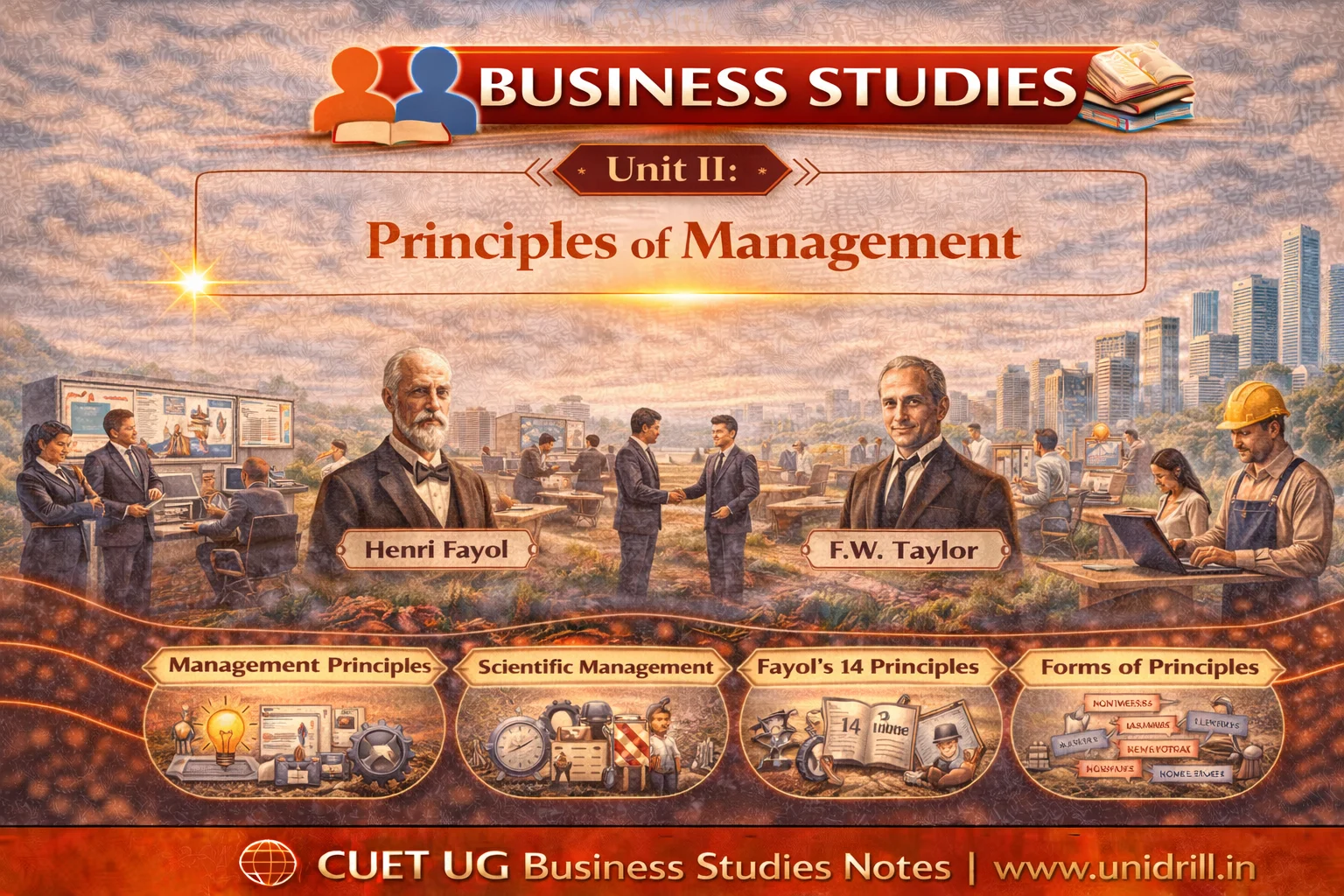
I. Principles of Management: Concept, Nature, and Significance
1. Meaning of Principles of Management Management principles are broad and general guidelines for managerial decision-making and behaviour.
They are distinct from techniques of management, which are specific procedures or methods involving a series of steps to accomplish goals.
While techniques are sequential, principles serve as the underlying guidelines for those actions.
Furthermore, principles must be distinguished from values; while values are moral connotations or general rules for societal behaviour, management principles are technical in nature and formed through research in work situations.
2. Nature of Principles of Management
The nature of management principles refers to their inherent qualities and characteristics. These have been developed through observation, experimentation, and the personal experiences of managers.
Universal Applicability: These principles are intended for all types of organisations, whether business or non-business, small or large, and across public and private sectors.
General Guidelines: They provide a framework for action but do not offer readymade "straitjacket" solutions because real business situations are complex and dynamic.
Formed by Practice and Experimentation: They are the result of collective wisdom and systematic experimentation over time.
Flexible: They are not rigid prescriptions; managers have the discretion to modify them according to the requirements of a specific situation.
Mainly Behavioural: Their primary aim is to influence and understand human behaviour within the organisation.
Cause and Effect Relationships: They establish a link between an action and its likely result, helping managers predict outcomes in similar situations.
Contingent: Their application depends on the prevailing situation at a particular point in time.
3. Significance of Principles of Management The importance of these principles lies in their utility for guiding managerial practices.
Providing Managers with Useful Insights into Reality: Adherence to principles adds to a manager's knowledge and ability to handle recurring problems efficiently based on past lessons.
Optimum Utilisation of Resources and Effective Administration: Principles help managers foresee cause-and-effect relationships, reducing wastage from trial-and-error approaches and limiting personal bias in decision-making.
Scientific Decisions: They encourage decisions based on facts and logic rather than blind faith or prejudice.
Meeting Changing Environment Requirements: Though general, they are flexible enough to help managers adapt to dynamic market conditions, such as through outsourcing and specialisation.
Fulfilling Social Responsibility: Interpretations of principles like 'Equity' have evolved to include care for the environment and social value.
Management Training, Education, and Research: These principles form the core of management theory used in professional courses like MBA and BBA and in developing new techniques like Lean Manufacturing.
II. Taylor’s Scientific Management
Fredrick Winslow Taylor, an American mechanical engineer, is known as the ‘Father of Scientific Management’.
He sought to replace the "rule of thumb" (management based on personal judgement and trial-and-error) with a scientific approach.
1. Principles of Scientific Management
Science, Not Rule of Thumb: This involves investigating traditional methods through work-study to find the "one best way" to perform a job, which increases efficiency and saves human energy.
Harmony, Not Discord: Taylor emphasised that there should be complete harmony between management and workers to avoid class conflict. He called for a Mental Revolution, where both parties transform their thinking to realise they need each other.
Cooperation, Not Individualism: This is an extension of the harmony principle, suggesting that competition should be replaced by cooperation. Management should encourage employee suggestions and include them in important decisions.
Development of Each and Every Person to Their Greatest Efficiency and Prosperity: Efficiency depends on personnel competencies. Workers should be scientifically selected and provided with the training necessary to learn the "best method".
2. Techniques of Scientific Management
Functional Foremanship: Taylor advocated the separation of planning and execution. He proposed eight specialist bosses to oversee workers: four for planning (Instruction Card Clerk, Route Clerk, Time and Cost Clerk, Disciplinarian) and four for execution (Speed Boss, Gang Boss, Repair Boss, Inspector).
Standardisation and Simplification of Work: Standardisation involves setting benchmarks for every business activity (processes, raw materials, time). Simplification aims at eliminating unnecessary diversity in products to reduce costs and inventory.
Method Study: The objective is to find the one best way of doing a job to minimise cost and maximise quality.
Motion Study: This involves studying movements like lifting or sitting to eliminate unproductive motions. Taylor demonstrated that productivity could increase fourfold by reducing unnecessary movements.
Time Study: It determines the standard time taken to perform a well-defined job to help frame incentive schemes and determine labour costs.
Fatigue Study: This determines the amount and frequency of rest intervals required for a worker to regain stamina and maintain productivity.
Differential Piece Wage System: Taylor wanted to reward efficient workers by paying a higher rate per unit to those who exceeded the standard output and a lower rate to those who fell below it.
Mental Revolution: This involves a change in the attitude of workers and management from competition to cooperation, aiming to increase the surplus rather than quarrelling over its distribution.
III. Fayol’s Principles of Management
Henri Fayol, a French management theorist, is known as the ‘Father of General Management’.
While Taylor focused on the shop floor, Fayol’s perspective was on top-level management.
The 14 Principles of Management:
Division of Work: Work is divided into small tasks performed by trained specialists, leading to specialisation and greater efficiency.
Authority and Responsibility: Authority is the right to give orders, and responsibility is its corollary. There must be a balance between the two so that managers have the power needed to carry out their duties.
Discipline: This involves obedience to organisational rules and agreements, which requires good superiors at all levels and fair agreements.
Unity of Command: An individual employee should receive orders from and be responsible to only one superior to avoid confusion and conflict.
Unity of Direction: All units of an organisation moving towards the same objective should have one head and one plan.
Subordination of Individual Interest to General Interest: The interests of the organisation must take priority over the interests of any individual employee.
Remuneration of Employees: Pay and compensation should be fair and equitable to both the employees and the organisation, ensuring a reasonable standard of living.
Centralisation and Decentralisation: Centralisation is the concentration of decision-making authority, while decentralisation is its dispersal. Fayol suggested a balance between the two based on the organisation's size and circumstances.
Scalar Chain: This is the formal line of authority from the highest to the lowest rank. Communication should follow this chain, but in emergencies, a "Gang Plank" can be used for direct communication between people at the same level.
Order: This principle states that there should be "a place for everything (everyone) and everything (everyone) in its (her/his) place" to ensure maximum efficiency.
Equity: Managers should be kind and just towards workers, ensuring a discrimination-free environment.
Stability of Personnel: Employee turnover should be minimised. Personnel should be selected through rigorous procedures and given a stable tenure to show results.
Initiative: Workers should be encouraged to conceive and execute plans for improvement, though this should not contradict established practices.
Esprit de Corps: Management should promote a team spirit of unity and harmony, replacing ‘I’ with ‘We’ in conversations to foster mutual trust.
V. Modern Scientific Management and Global Trends
The evolution of management principles continues with contemporary techniques derived from earlier theories.
Lean Manufacturing: A philosophy focusing on the reduction of seven wastes (overproduction, waiting, transportation, etc.) to improve quality and reduce costs.
Kaizen: A Japanese term meaning "change for better" or continuous improvement. It involves daily activities to eliminate waste and humanise the workplace.
Six Sigma: A data-driven approach aimed at bringing down inefficiencies by reducing quality variations, allowing no more than 3-4 defects per million opportunities.
Just In Time (JIT): An inventory strategy to improve return on investment by reducing in-process inventory using visual signals like Kanban.
Empowerment: In modern flat structures, Fayol's principle of authority has evolved into the empowerment of employees rather than just managers.
Performance-based Reward: Fayol's principle of remuneration is now often interpreted as performance-based systems rather than just reasonable fixed pay.