
CONCEPT, NATURE AND CHARACTERISTICS OF MANUFACTURING
All economic activities—primary, secondary, tertiary and quaternary—are fundamentally concerned with obtaining and utilising resources necessary for human survival.
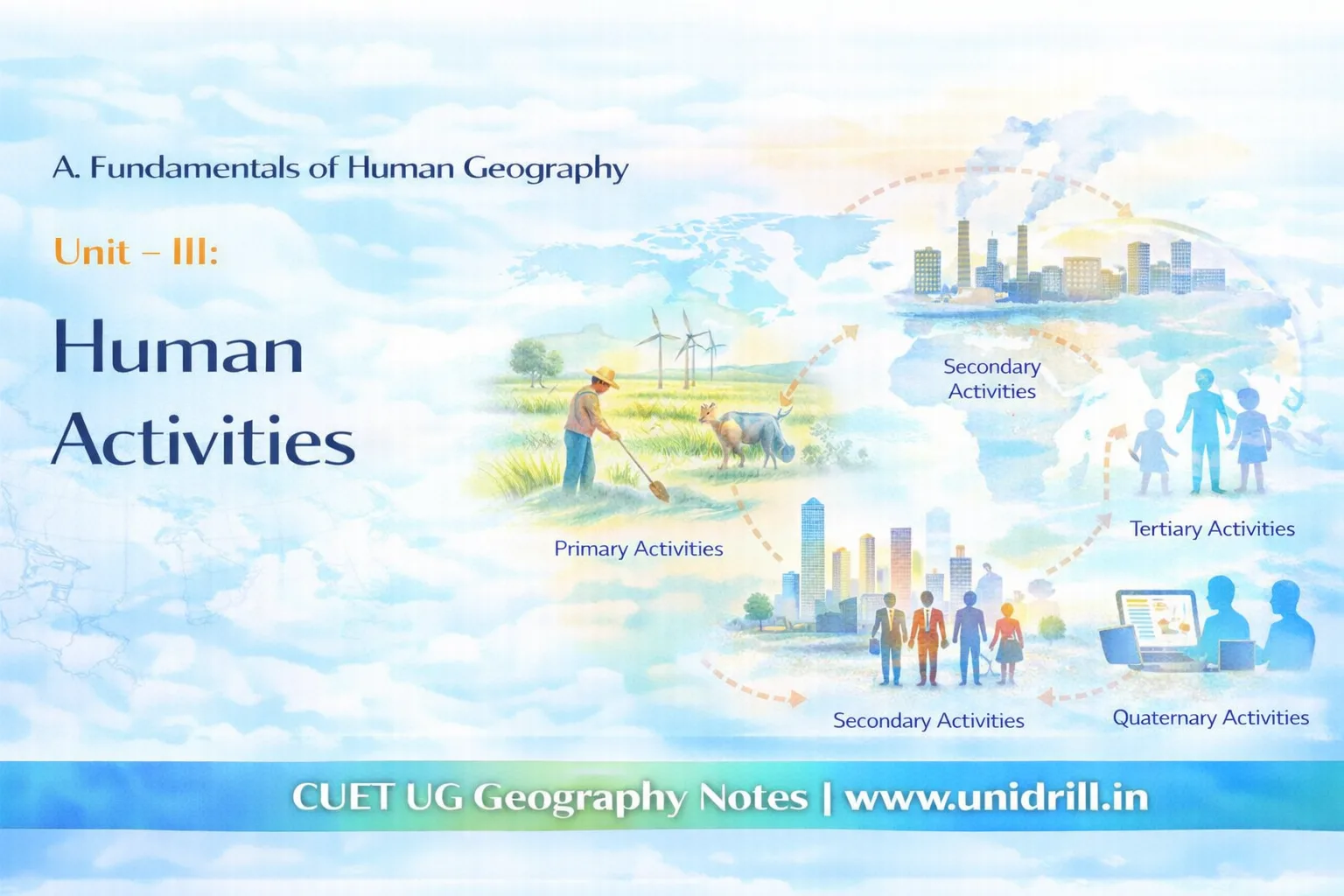
Among these, secondary activities occupy a crucial position because they add value to natural resources by transforming raw materials into more useful and valuable products.
For instance, cotton in its raw form has limited utility, but once it is converted into yarn and further into cloth, its value increases significantly.
Similarly, iron ore extracted from mines cannot be used directly; however, when processed into steel, it becomes the foundation for manufacturing machines, tools and infrastructure.
Thus, secondary activities act as a bridge between raw materials and finished goods.
Secondary activities include manufacturing, processing and construction (infrastructure development). They utilise materials obtained from the farm, forest, mines and seas and convert them into products suitable for consumption or further production.
Manufacturing: Meaning and Scope
Manufacturing refers to a wide range of production activities, from simple handicrafts to highly advanced industrial processes such as assembling computer components or space vehicles. Despite this diversity, certain common features define manufacturing processes:
The application of power and machinery
Mass production of identical goods
Use of specialised labour
Production of standardised commodities in factory settings
Manufacturing may be carried out using modern machinery and automation or through primitive methods involving manual labour. In many developing countries, production still takes place in a literal sense of “making by hand,” reflecting less complex industrial systems.
Manufacturing and Industry: Conceptual Distinction
Although the terms “manufacturing” and “industry” are often used interchangeably, they have distinct meanings. Manufacturing is essentially the process of transforming raw materials into finished goods of higher value for sale in local or distant markets.
On the other hand, an industry refers to a geographically located manufacturing unit that operates under a management system and maintains records.
The term “industry” is broader and may also include non-factory activities such as the tourism or entertainment industry. Therefore, for clarity, the term “manufacturing industry” is often used when referring specifically to factory-based production.
Characteristics of Modern Large-Scale Manufacturing
Modern large-scale manufacturing is marked by several defining characteristics:
1. Specialisation of Skills and Methods of Production
There has been a shift from the traditional craft method—where products are made individually and to order—to mass production, where large quantities of standardised parts are produced. Workers perform specialised tasks repeatedly, increasing efficiency and reducing costs.
2. Mechanisation and Automation
Mechanisation involves the use of machines to perform tasks, reducing manual effort. Automation represents a more advanced stage, where machines operate with minimal human intervention through feedback and computer-controlled systems. Such systems are capable of self-regulation, enhancing productivity and precision.
3. Technological Innovation
Modern manufacturing relies heavily on research and development (R&D). Technological innovations help in:
Maintaining quality control
Reducing waste and inefficiency
Addressing environmental concerns such as pollution
4. Organisational Structure and Stratification
Large-scale industries require:
Enormous capital investment
Complex machinery
Highly organised administrative structures
There is an extreme division of labour, and production is managed through hierarchical organisational systems.
5. Uneven Geographic Distribution
Manufacturing activities are highly concentrated in certain regions of the world, covering less than 10 per cent of the total land area.
These regions have emerged as centres of economic and political power. Industrial areas are characterised by high intensity, where a small geographical area can employ thousands of workers, unlike agriculture which requires larger land areas.
FACTORS OF INDUSTRIAL LOCATION AND TYPES OF INDUSTRIES (SIZE BASIS)
Industries aim to maximise profits by minimising costs. Therefore, they tend to locate in areas where production costs are lowest. Several factors influence the location of industries, and these factors often operate together rather than independently.
Factors Influencing Industrial Location
1. Access to Market
The most important factor is the availability of a market. A market consists of people who have both the demand and purchasing power to buy goods. Developed regions with high purchasing power and densely populated regions with large populations both provide favourable markets.
2. Access to Raw Materials
Industries require raw materials that are cheap and easy to transport. Industries using bulky or weight-losing raw materials, such as iron and steel or cement, are located near the source of raw materials.
Similarly, industries dealing with perishable goods, such as dairy or food processing, are also located close to their raw material sources.
3. Access to Labour Supply
Labour is an essential factor in industrial location. Certain industries require skilled labour, although increasing mechanisation and automation have reduced dependence on manual labour. Nevertheless, the availability of labour remains important.
4. Access to Sources of Energy
Industries that require large amounts of power are located near energy sources. While coal was historically the main source of energy, modern industries also rely on hydroelectricity and petroleum.
5. Transport and Communication
Efficient transport systems are necessary for moving raw materials to factories and finished goods to markets. Regions with well-developed transport networks, such as Western Europe and North America, have historically attracted industries. Communication systems are equally important for managing and exchanging information.
6. Government Policy
Governments influence industrial location through regional policies aimed at achieving balanced economic development. They may encourage industries to set up in specific regions.
7. Agglomeration Economies
Industries benefit from being located near each other. Such clustering leads to cost savings through shared services, infrastructure and linkages between industries. These benefits are known as agglomeration economies.
Footloose Industries
Footloose industries are not dependent on any specific raw material or location. They:
Use easily transportable components
Operate on a small scale
Employ a small labour force
Are generally non-polluting
Their location is mainly determined by accessibility, especially road networks.
Industries Based on Size
Industries are classified into three categories based on capital investment, labour employed and volume of production:
1. Household or Cottage Industries
These are the smallest manufacturing units. Production takes place at home using local raw materials and simple tools. Family members or part-time labour are involved.
Products may be consumed locally, sold in nearby markets or exchanged through barter. Examples include pottery, weaving, handicrafts, furniture making and jewellery.
2. Small Scale Manufacturing
These industries operate in workshops outside homes. They use local raw materials, simple machines and semi-skilled labour. Small-scale industries play a significant role in providing employment and increasing local purchasing power, particularly in developing countries.
3. Large Scale Manufacturing
Large-scale industries require:
Large capital
Advanced technology
Skilled labour
Large markets
They involve assembly-line production and mass manufacturing. These industries first developed in regions like the United Kingdom, the United States and Europe and have now spread worldwide.
Types of Industrial Regions
Large-scale manufacturing regions can be broadly divided into:
Traditional industrial regions concentrated in developed countries
High-technology industrial regions that have spread to developing countries
CLASSIFICATION BASED ON MATERIALS, OWNERSHIP, OUTPUT AND HIGH-TECH INDUSTRIES
Industries Based on Raw Materials
1. Agro-Based Industries
These industries process agricultural products into finished goods. Examples include food processing, sugar, textiles, beverages and rubber industries. Food processing involves techniques such as canning, drying and fermenting. Modern developments have led to agri-business, which involves large-scale, mechanised and commercially oriented farming.
2. Mineral-Based Industries
These industries use minerals as raw materials. They may be:
Ferrous (iron and steel industries)
Non-ferrous (aluminium, copper industries)
Non-metallic (cement, pottery industries)
3. Chemical-Based Industries
These industries use natural or synthetic chemical materials. Examples include petrochemicals, plastics and synthetic fibres. Raw materials may be derived from petroleum, salts, sulphur, wood or coal.
4. Forest-Based Industries
These industries use forest products such as timber, bamboo and lac. Examples include furniture manufacturing, paper production and lac industries.
5. Animal-Based Industries
These industries utilise animal products such as wool, leather and ivory. Examples include woollen textiles and leather goods.
Industries Based on Ownership
Industries may also be classified according to ownership:
Public Sector Industries: Owned and managed by the government
Private Sector Industries: Owned by individuals or private organisations
Joint Sector Industries: Managed jointly by public and private sectors
Industries Based on Output
1. Basic Industries
These industries produce raw materials for other industries. For example, iron and steel industries produce materials used to manufacture machines, which in turn produce consumer goods.
2. Consumer Goods Industries
These industries produce goods for direct consumption, such as bread, soap, paper and electronic goods.
Concept of High-Technology Industry
High-technology industries represent the most advanced stage of manufacturing. They are characterised by intensive research and development and the production of technologically sophisticated goods.
Key features include:
Dominance of highly skilled professionals
Use of robotics and automation
Application of computer-aided design and manufacturing
Continuous innovation in products and processes
The physical layout of high-tech industries differs from traditional industries. Instead of large factories, they consist of modern, low-rise buildings such as offices, laboratories and research centres. These industries are often located in planned business parks.
Highly specialised and concentrated high-tech industrial regions are known as technopolies.