
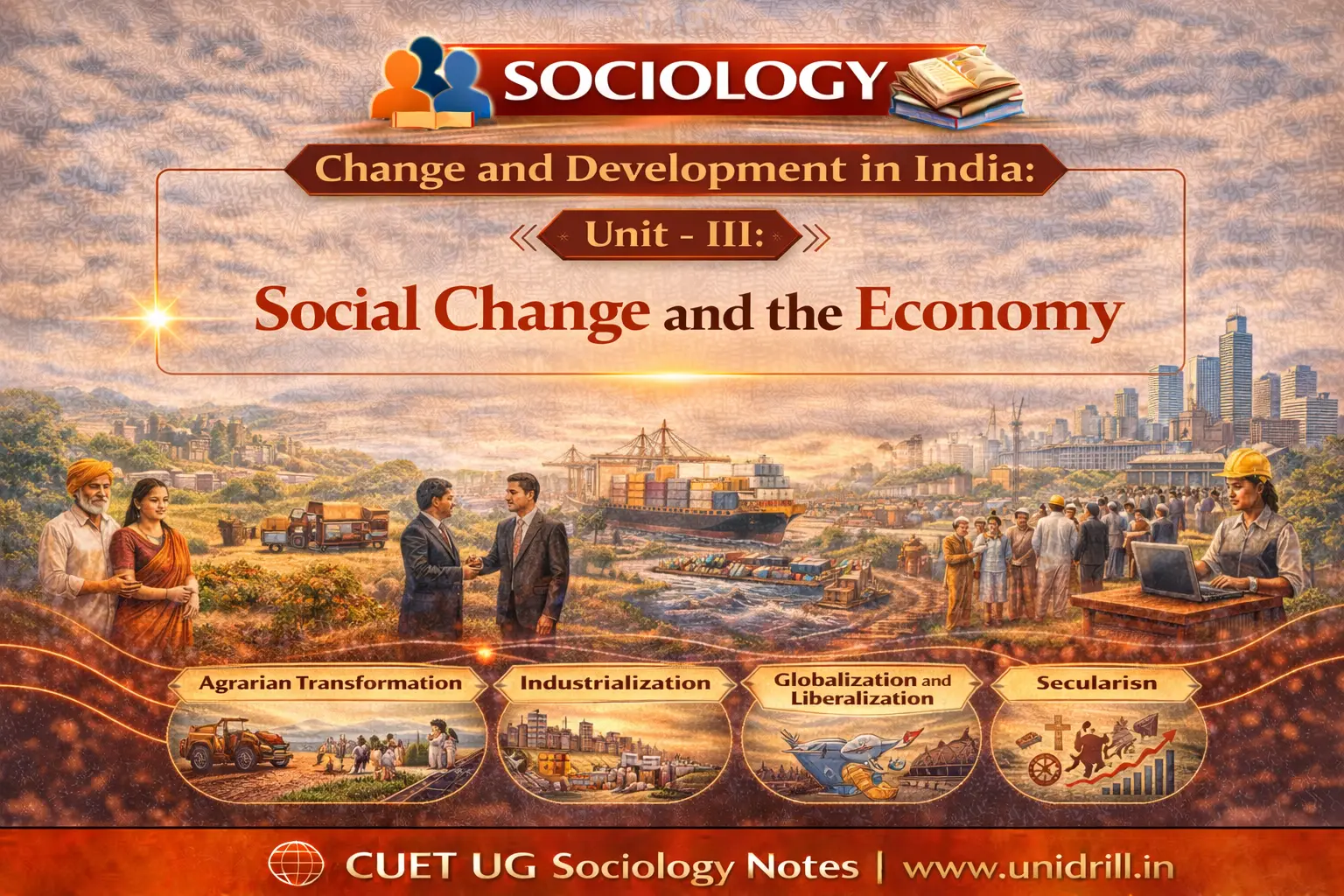
Social Change and the Economy: Transformation of Indian Society
Introduction
Economic change is a primary driver of social transformation.
In India, the transition from a colonial economy to a planned developmental state and, finally, to a liberalised global market has fundamentally altered social relations.
Sociologists view the market as a socially embedded institution, where economic exchange is linked to other social structures like caste, kinship, and class.
To understand contemporary India, one must examine the shifts in agrarian society, the path of industrialisation, and the resulting changes in the class structure.
I. Agrarian Society: Land Reforms and the Green Revolution
Agriculture remains the backbone of Indian society, with 69 per cent of the population living in rural areas as of 2011.
Land is not merely a productive resource; it is a form of property and a way of life that shapes cultural practices, such as harvest festivals like Pongal, Bihu, and Baisakhi.
1. The Colonial Legacy and Land Reforms
During the colonial period, the British implemented systems like the Zamindari system, where landlords (often from high castes) extracted heavy revenue from cultivators, leading to agricultural stagnation and frequent famines.
After Independence, the government embarked on a program of planned development and land reforms to address low productivity and rural poverty.
Objectives: The reforms sought to abolish intermediaries, implement land ceilings, and redistribute land to the landless to ensure social justice.
Outcome: While the structure changed from colonial times, it remained highly unequal. In many regions, a "proprietary caste" continued to own most resources, often employing low-caste groups through exploitative or hereditary labour relationships, such as begar (free labour).
2. The Green Revolution: Phases and Impacts
The Green Revolution of the 1960s and 1970s was a government program for agricultural modernisation funded by international agencies.
It introduced high-yielding variety (HYV) seeds, pesticides, and fertilisers, primarily in areas with assured irrigation like Punjab, Haryana, western U.P., and coastal Andhra Pradesh.
First Phase (1960s-70s): This phase focused on wheat and rice-growing areas. While it made India self-sufficient in food grains, it increased rural inequality. Medium and large farmers benefited most because they had the capital to afford expensive inputs, whereas small farmers could not. This led to a process of differentiation, where the rich grew richer while the poor stagnated.
Second Phase (1980s onwards): Green Revolution practices spread to dry and semi-arid regions. This led to increased commercialisation and a shift toward cash crops (e.g., cotton), which increased livelihood insecurity.
Social Consequences:
Displacement: The introduction of machinery like tractors and harvesters displaced traditional service castes.
Labour Shifts: Traditional bonds of patronage shifted toward exploitation, as payments moved from kind (grain) to cash.
Regional Inequality: Prosperity was concentrated in the West and South, while eastern regions like Bihar and eastern U.P. stagnated due to entrenched "feudal" structures.
3. Agrarian Distress and Globalisation
Since the 1990s, liberalisation has exposed Indian farmers to global competition. The withdrawal of state support (subsidies and support prices) and the shift to high-cost inputs have contributed to a spate of farmers' suicides.
Processes like contract farming (e.g., growing tomatoes for PepsiCo) provide a market but make farmers dependent on multinational corporations, often rendering their indigenous knowledge irrelevant.
II. Industrialisation: From Planning to Liberalisation
Industrialisation in India has followed a path distinct from the West, influenced heavily by the colonial experience and subsequent state policies.
1. Planned Industrialisation (Early Independence)
In the early decades after 1947, the Indian state played an active role in promoting industry, responding to the deindustrialisation caused by British rule (where traditional handlooms were destroyed by cheap British textiles).
Heavy Industry: The state promoted heavy industries and infrastructure, leading to the emergence of industrial towns like Bhilai, Rourkela, and Durgapur.
Public Sector Expansion: This era was marked by the growth of the organised sector, which offered secure, salaried employment and government-mandated benefits.
2. The Shift to Liberalisation (Post-1991)
Since the late 1980s and officially in 1991, India adopted liberalisation (or marketisation), reducing government control over the economy.
Key Policies: These included the privatisation (or disinvestment) of public sector enterprises, loosening of regulations on capital and trade, and reduction of import duties.
Multinational Influence: Multinational companies entered the Indian market, often buying out local brands (e.g., Coca-Cola buying Parle).
Growth of Services: While agriculture still employs nearly 43% of the workforce (as of 2018-19), the service sector (IT, retail, financial services) now contributes more than half of India's economic growth.
3. The "New Economy" and Labour
Liberalisation has led to the rise of the knowledge economy, particularly software services and Business Process Outsourcing (BPO).
Flexibility and Insecurity: While these sectors offer high salaries to professionals, they often use contract labour, making jobs more insecure.
Unorganised Sector: Over 90% of India's workforce remains in the unorganised or informal sector, where workers lack regular salaries and social security. Even in industry, a shift toward casual labour is evident as companies seek to reduce costs.
III. Changes in the Class Structure
Economic shifts have produced profound changes in India's social hierarchy, often reinforcing existing inequalities while creating new elite groups.
1. The Rural Class Structure and the "Dominant Caste"
The enrichment of medium and large farmers during the Green Revolution altered rural social structures.
Entrepreneurial Groups: In agriculturally rich regions (e.g., coastal AP, Gujarat, western U.P.), well-to-do farmers from dominant castes (like Jats, Vokkaligas, Reddis) invested their agricultural profits into business ventures and private professional colleges.
Consolidation: This gave rise to a new rural-urban dominant class that is economically and politically powerful.
2. The Rise of the Urban Middle Class
The expansion of the service sector and professional education has fed into the growth of the urban middle class.
Knowledge-Based Elite: A class of upwardly mobile professionals has emerged in metropolitan cities, working in software, banking, fashion, and media.
Caste and Capital: The urban upper-caste elite were best positioned to take advantage of these new opportunities because they already possessed the necessary economic and cultural capital (educational qualifications). For this group, caste has become "invisible" in public life, though it remains central to their private spheres (marriage and kinship).
3. The Underclass and "Footloose" Labour
At the bottom of the structure, a large underclass persists, often composed of Scheduled Castes, Scheduled Tribes, and lower OBCs.
Circulation of Labour: As traditional patronage broke down, a pattern of seasonal migration emerged. Thousands of landless workers, termed "footloose labour", circulate between drought-prone regions and prosperous agricultural zones or urban construction sites.
Insecurity: These workers are often poorly paid, lack job security, and live in harsh conditions, yet they are "more free" than the debt-bonded labourers of the past because they can break contracts to find new employers.
4. Commodification and Lifestyle
Globalisation has led to the commodification of things that were once outside the market, such as marriage (through bureaus/websites) and social skills (through personality development classes).
As pointed out by Max Weber, classes are now increasingly differentiated on the basis of lifestyle.
Goods like specific brands of cell phones or cars serve as status symbols, marking one's socio-economic position in a consumer-driven society.