
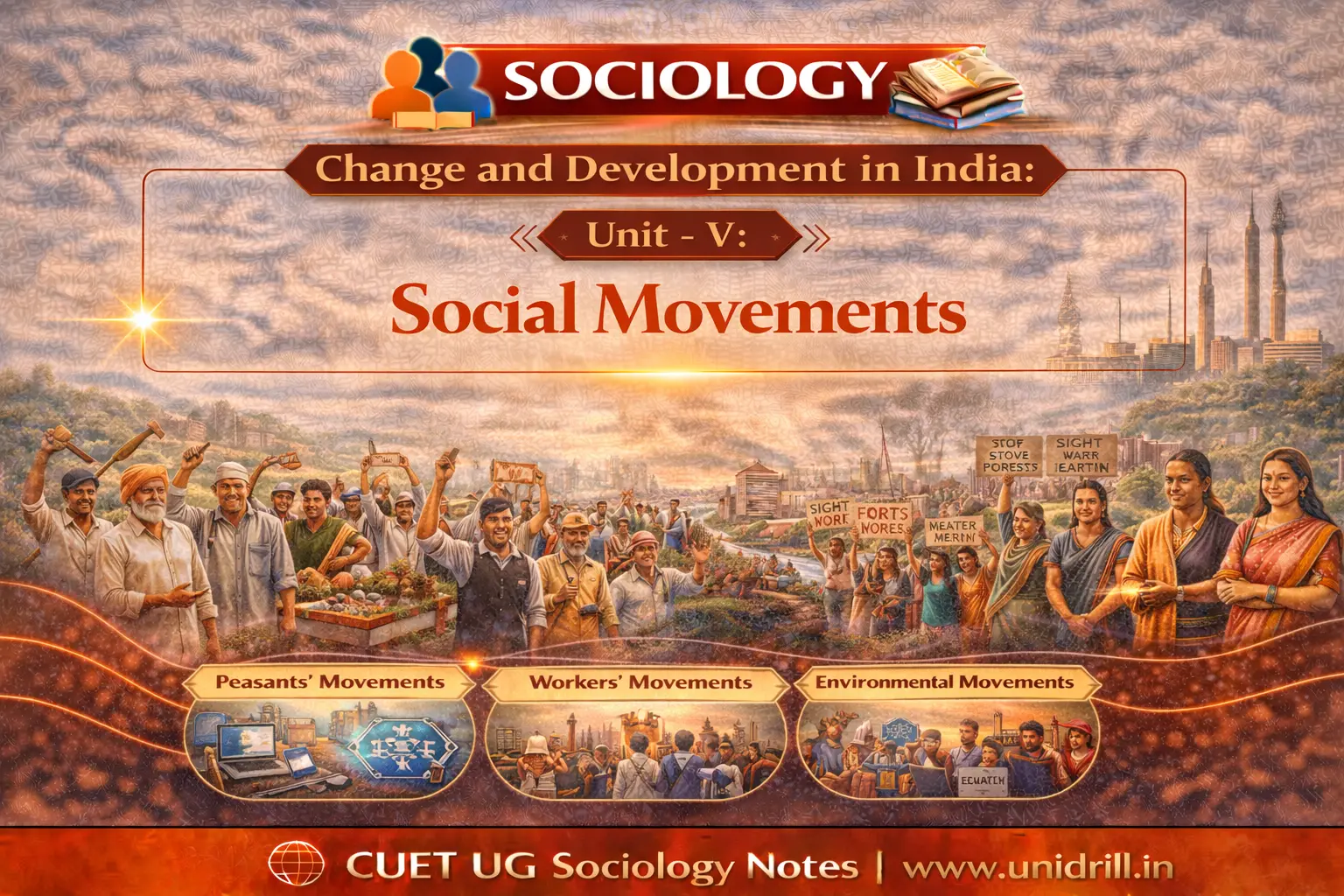
Social Movements in Indian Society
I. Understanding Social Movements: Nature and Classification
A social movement is defined by sustained collective action directed toward specific goals, often involving demands for changes in state policy or practice.
Unlike spontaneous protests, social movements require a degree of organisation, including leadership, a structure defining member relationships, and shared ideologies.
They play a crucial role in shaping the world; for example, rights like the eight-hour workday, equal pay, and social security were all products of past struggles.
Sociologists classify social movements into three broad types:
Redemptive (Transformatory): Aims to change the personal consciousness and actions of individual members (e.g., Narayana Guru’s efforts with the Ezhava community).
Reformist: Seeks to change existing social and political arrangements through gradual, incremental steps (e.g., the Right to Information campaign).
Revolutionary: Attempts to radically transform social relations, often by capturing state power (e.g., the Naxalite movement).
A distinction is also made between "old" and "new" movements. Old movements (like those of workers and peasants) focused primarily on the reorganisation of power relations and economic inequality.
New social movements (like environmental or women’s movements) often focus on quality-of-life issues and identity politics, often uniting participants across class boundaries.
II. Class-Based Movements: Workers and Peasants
1. Peasant Movements
Agrarian struggles have existed since pre-colonial days but were initially localised and disjointed.
Colonial Era: Early notable revolts included the Bengal revolt (1859-62) against indigo plantations and the Deccan riots (1857) against moneylenders. Under Mahatma Gandhi, these became linked to the nationalist struggle, seen in the Champaran Satyagraha (1917–18) and the Bardoli Satyagraha (1928).
Organisational Growth: The Bihar Provincial Kisan Sabha (1929) and the All India Kisan Sabha (1936) were founded to demand freedom from economic exploitation.
Independence Era Struggles: The Tebhaga movement (1946–47) saw sharecroppers in Bengal demand a two-thirds share of produce, while the Telangana movement (1946–51) fought feudal conditions in Hyderabad.
New Farmer’s Movements: Emerging in the 1970s (notably in Punjab and Tamil Nadu), these were non-party movements involving market-oriented farmers. They focused on price-related issues (procurement prices, input costs) and used novel methods like blocking roads and railways.
2. Workers’ Movements
The industrial working class emerged alongside factory production in the 1860s, primarily in port towns like Calcutta and Bombay.
Early Phase: Initial protests were spontaneous rather than sustained, as the colonial government did not regulate wages or conditions.
Rise of Trade Unions: The first trade union was the Madras Labour Union (1918). In 1920, the All India Trade Union Congress (AITUC) was formed, involving diverse ideologies from communists to nationalists like Jawaharlal Nehru.
Post-Independence: In 1947, the INTUC was formed as a split from AITUC. Major post-independence actions include the 1974 railway strike and the Bombay Textile Strike of 1982. The latter, led by Dr. Datta Samant, lasted nearly two years and involved a quarter of a million workers fighting for better wages and the right to form their own union.
III. Caste-Based Movements: Identity and Assertion
1. The Dalit Movement
The Dalit movement is not merely about economic or political oppression; it is a struggle for recognition as fellow human beings and the abolishment of the stigma of untouchability.
Terminology: The term ‘Dalit’ (meaning ‘downtrodden’) was popularised in the 1970s by the Dalit Panthers in western India to assert identity and dignity.
Diverse Struggles: Key historical movements include the Satnami movement (Chattisgarh), the Adi Dharma movement (Punjab), the Mahar movement (Maharashtra), and the Anti-Brahman movement in South India.
Literature and Culture: Contemporary movements are accompanied by a robust body of Dalit literature, which uses unique imagery rooted in lived experience to call for a social and cultural revolt.
Nature of Movement: While it contains revolutionary elements aiming to abolish caste oppression, on the whole, it is often viewed as a reformist movement that has achieved gains for educated sections but struggled to lift the masses out of extreme poverty.
2. Backward Caste Movements
Backward castes emerged as political entities in both colonial and post-colonial contexts.
Horizontal Stretch: To counter the colonial state’s distribution of patronage by caste, similarly placed groups united to form a "horizontal stretch" for political mobilisation.
Politicisation: The term ‘Backward Classes’ gained wide usage in Madras (1872) and Mysore (1918). By the 1990s, the politicisation of Other Backward Classes (OBCs) allowed them to convert their large numbers (roughly 41% of the population) into significant national political influence.
3. Trends in Upper Caste Responses
Social movements often trigger counter-movements from those defending the status quo.
Historical Resistance: When reformers attacked sati, the Dharma Sabha petitioned the British to keep it. Reformers for women’s education and widow remarriage faced social boycotts.
Modern Retaliation: Proposals for extending reservations in education and jobs have frequently led to counter-movements by upper castes.
Policy Shift: In 2019, the government introduced a 10% reservation for Economically Weaker Sections (EWS) among upper castes, marking a new trend in addressing economic disadvantage within traditionally dominant groups.
IV. Women’s Movements in Independent India
The "women’s question" in India has evolved from 19th-century reform to contemporary political assertion.
19th Century Origins: Early movements were led by middle-class, western-educated reformers (e.g., Raja Rammohun Roy, Jyotiba Phule) focusing on "social evils" like sati and child marriage.
Early 20th Century: National-level organisations like the Women’s India Association (WIA) and the All India Women’s Conference (AIWC) emerged, eventually linking women's rights to the struggle for national freedom.
Renewal in the 1970s: After a post-independence lull, the movement was renewed with a focus on "modern" issues: violence against women, representation in popular media, and the gendered consequences of development.
Key Issues: Campaigns have targeted land rights, employment, sexual harassment, and dowry. A significant recent challenge is the sharp fall in the child sex ratio, which reflects implicit social bias against girls.
Patriarchy: There is a growing recognition that patriarchy constrains both men and women, and a "gender-just society" (supported by initiatives like Beti Bachao, Beti Padhao) would allow freedom for both.
V. Tribal Movements
Tribal movements are unique because Adivasis were often concentrated in contiguous areas, allowing them to demand separate statehood.
Core Issues: These movements typically revolve around control over economic resources (land and forests) and matters of ethnic-cultural identity.
Displacement and "Dikus": National development projects (dams, mines) have historically displaced millions of Adivasis, often viewed as a form of internal colonialism. Resistance is often directed against dikus (migrant traders and moneylenders) who grabbed local wealth.
The Case of Jharkhand: The formation of Jharkhand in 2000 followed a century of resistance. Leaders like Birsa Munda became icons, and the emergence of an educated Adivasi middle class helped create a unified ethnic consciousness and lobby for a separate state.
North-East: Movements here often focus on preserving traditional autonomy and identity against incorporation into the administrative machinery of larger states.
VI. Environmental Movements
Ecological movements critique the modern development model for its unchecked use of natural resources and the displacement of people.
The Chipko Movement: Originating in the Himalayan foothills in the 1970s, it is the most famous example. Villagers, led by women like Gaura Devi, hugged trees to prevent them from being cut by government contractors.
Interlinked Interests: For the villagers, Chipko was about subsistence (firewood, fodder) vs. profit (timber). It interlinked "red" issues (social inequality) with "green" issues (ecological sustainability).
Broader Impact: Chipko highlighted how environmental destruction results in floods and landslides, making it a matter of survival for local communities. Modern state efforts, such as Namami Gange and Swachh Bharat Abhiyan, are viewed as systematic attempts to address these ecological balances.