
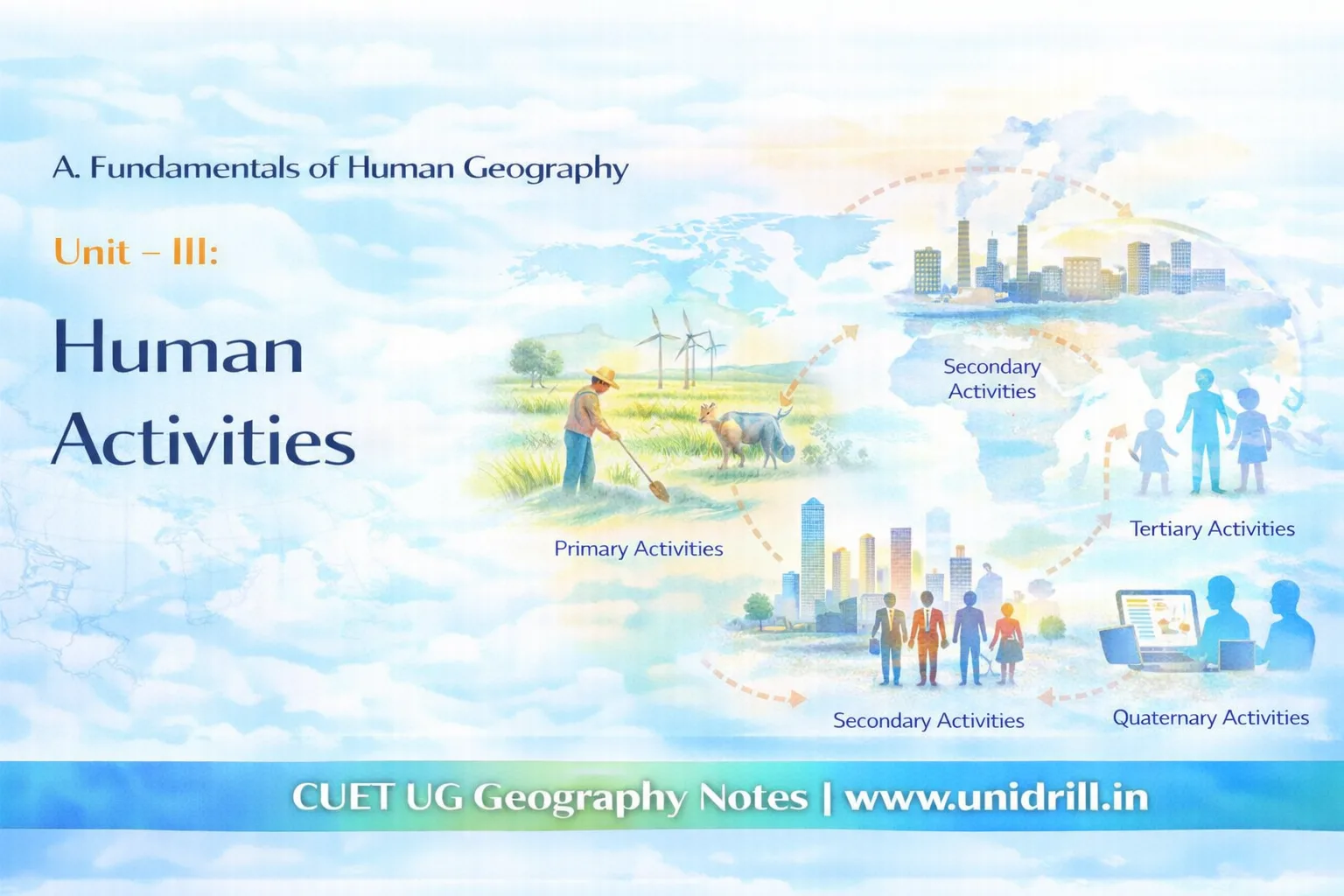
Nature, Characteristics and Types of Tertiary Activities
Tertiary activities are an essential component of the service sector and represent all those activities in which services are provided in exchange for payment. In everyday life, individuals depend on a wide range of professionals such as doctors, teachers, lawyers and technicians who offer specialised services.
These services are not tangible goods but involve the application of skill, knowledge and expertise. Thus, tertiary activities can be understood as activities that provide special skills supported by theoretical knowledge and practical training.
A significant feature of tertiary activities is the dominant role of manpower. Most services are performed by skilled labour, trained professionals, and consultants. As economies develop, there is a structural shift in employment.
In the early stages of economic development, the majority of the population is engaged in primary activities.
However, in developed economies, a larger proportion of workers is employed in tertiary activities, while the secondary sector employs a moderate proportion. This reflects the growing importance of services in modern economic systems.
Tertiary activities include both production and exchange. Production, in this context, refers to the provision of services that are consumed by individuals or organisations.
Unlike physical goods, the output of these activities is intangible and is measured indirectly through wages and salaries. Exchange involves trade, transport, and communication, which help overcome the barrier of distance.
Thus, tertiary activities are concerned with the commercial output of services rather than the processing of raw materials.
The primary distinction between secondary and tertiary activities lies in their dependence on human skills. While secondary activities rely heavily on machinery, production techniques and factory processes, tertiary activities depend more on specialised knowledge, experience and human expertise.
One of the major components of tertiary activities is trade and commerce. Trade involves the buying and selling of goods produced elsewhere.
Over time, trade has evolved from a simple barter system at the local level to complex international systems based on money exchange. This evolution has led to the development of trading centres, which act as collection and distribution points.
Trading centres can be broadly classified into rural and urban marketing centres. Rural marketing centres cater to nearby settlements and function as quasi-urban centres.
They serve as local hubs for the collection and distribution of goods and often include mandis or wholesale markets. However, these centres generally lack well-developed personal and professional services.
Periodic markets are another feature of rural areas, especially where permanent markets are absent. These markets operate at fixed intervals, such as weekly or bi-weekly, and move from one place to another, serving a large geographical area.
Urban marketing centres, on the other hand, are highly specialised and provide a wide range of goods and services.
In addition to manufactured goods, they offer specialised services such as education, healthcare, and legal consultancy. They also host specialised markets for labour, housing, and semi-finished or finished goods.
Retail trading is another important aspect of tertiary activities. It involves the sale of goods directly to consumers. Most retail trade takes place in fixed establishments such as shops and stores.
However, non-store retailing methods such as street vending, door-to-door sales, mail order, telephone sales, and internet-based transactions are also common.
Innovations in retailing include consumer cooperatives, departmental stores and chain stores. Chain stores, in particular, benefit from economies of scale and can standardise operations across multiple locations.
Wholesale trading, in contrast, involves bulk transactions carried out through intermediary merchants. Wholesalers act as a link between producers and retailers, often supplying goods on credit. This allows retailers to operate with limited capital and ensures a smooth flow of goods in the market.
Transport is another crucial tertiary activity. It refers to the movement of people, goods and materials from one place to another.
Transport is an organised industry that fulfils the basic human need for mobility. It plays a vital role in the production, distribution and consumption of goods, and significantly enhances the value of materials at every stage.
Transport distance can be measured in three ways: actual distance (in kilometres), time distance (time taken to travel), and cost distance (expense incurred). The choice of transport depends largely on time and cost considerations.
As transport systems develop, they form networks consisting of nodes and links. Nodes represent points of origin, destination or junctions, while links are the routes connecting them. A well-developed network ensures better accessibility and connectivity.
The demand for transport is influenced by population size, while routes are determined by factors such as the location of settlements, industrial centres, availability of resources, nature of terrain, climatic conditions and financial resources.
Communication, Services, Employment and Tourism
Communication is an integral part of tertiary activities and involves the transmission of words, messages, facts and ideas.
Historically, communication was closely linked to transport, as messages were physically carried by people, animals or vehicles. However, technological advancements have made communication increasingly independent of transport systems.
Telecommunications have revolutionised communication by drastically reducing the time required to transmit information. Modern developments such as mobile telephony have made communication instantaneous and accessible from any location. Traditional systems like telegraph and telex have become obsolete.
Mass media, including radio and television, play a vital role in disseminating information to large audiences and are important for entertainment and advertising.
Newspapers continue to provide global coverage of events, while satellite communication enables the transmission of information across the world. The internet has emerged as the most transformative innovation, revolutionising global communication systems.
Services within the tertiary sector operate at different levels. Some services cater to industries, others to individuals, and some serve both.
Low-order services, such as grocery shops and laundries, are widespread and cater to everyday needs. High-order services, such as those provided by consultants, accountants and physicians, are specialised and less common.
The nature of work in services varies between physical and mental labour. Occupations such as gardening and laundry involve physical effort, whereas professions like teaching, law and medicine require intellectual skills. The availability of services often depends on the ability of consumers to pay.
Many services are regulated by governments or corporations to ensure efficiency and public welfare. These include infrastructure services such as roads, bridges, fire departments, and education systems, as well as utilities like transport, telecommunications, energy and water supply.
Personal services are essential for daily life and are often provided by unskilled workers who migrate from rural areas in search of employment. These workers are typically employed in domestic services and belong to the unorganised sector.
A notable example is the dabbawala system in Mumbai, which efficiently delivers meals to thousands of people. Professional services, on the other hand, include healthcare, legal services, engineering and management.
In modern economies, a large proportion of the workforce is engaged in tertiary activities. Developed countries, in particular, have a higher percentage of service workers compared to developing countries. Employment in this sector has been steadily increasing, while the share of primary and secondary sectors has remained stable or declined.
Tourism is one of the most significant tertiary activities in the world. It involves travel for recreational purposes and has become the largest service industry in terms of employment and revenue generation.
Tourism supports various related activities, including accommodation, transport, entertainment and retail trade. It also promotes the development of infrastructure and local industries such as handicrafts.
Tourist regions vary widely and include coastal areas, mountainous regions, historic towns and national parks. Popular destinations include the Mediterranean region, the west coast of India and snow-covered mountain areas suitable for winter sports.
Several factors influence tourism. Climate plays a crucial role, as tourists often seek warm, sunny conditions or snow-covered landscapes depending on their preferences.
Landscape is another important factor, with natural beauty such as mountains, lakes and coastlines attracting visitors.
Historical and cultural features, including monuments, heritage sites and local traditions, also contribute to the attractiveness of a destination. Economic factors, such as affordability and availability of facilities, further influence tourist flows.
Medical tourism is an emerging trend in which people travel to other countries for medical treatment. Countries like India have become popular destinations due to the availability of high-quality healthcare services at lower costs.
Medical tourism also includes the outsourcing of diagnostic services such as radiology and MRI analysis, providing benefits to both patients and healthcare providers.
Quaternary and Quinary Activities, Outsourcing and Digital Divide
Quaternary activities represent an advanced form of the service sector and are centred on knowledge-based functions.
These activities involve the collection, production and dissemination of information. They are closely associated with research and development and require a high level of technical skills and specialised knowledge.
The quaternary sector has gained prominence in modern economies and, along with the tertiary sector, has replaced primary and secondary activities as the main source of employment.
In developed countries, a significant proportion of the workforce is engaged in knowledge-based services such as finance, education, healthcare and information technology. These activities are not dependent on natural resources or specific locations and can often be outsourced.
Quinary activities represent the highest level of decision-making in the service sector. They involve policy formulation, strategic planning and the interpretation of complex data and ideas.
These activities are performed by highly skilled professionals such as corporate executives, government officials, scientists and consultants. Often referred to as “gold collar” professions, they play a crucial role in shaping economic and social structures despite their relatively small numbers.
Outsourcing is a key feature of modern economic systems and involves contracting work to external agencies to improve efficiency and reduce costs.
When such activities are transferred to overseas locations, the process is known as offshoring. Outsourcing is common in sectors such as information technology, customer support, human resources and engineering.
The distinction between Business Process Outsourcing (BPO) and Knowledge Process Outsourcing (KPO) is significant.
BPO involves routine and standardised tasks such as call centre operations, whereas KPO involves specialised, knowledge-intensive activities such as research, legal services and intellectual property analysis. KPO requires highly skilled workers and offers greater value addition.
Outsourcing has led to the growth of service industries in developing countries, where skilled labour is available at lower costs.
Countries such as India, China and the Philippines have become major hubs for outsourcing activities. While outsourcing creates employment opportunities in these countries, it has also led to concerns about job losses in developed nations.
However, the principle of comparative advantage continues to drive this trend.
Another important concept in the modern service economy is the digital divide. This refers to the unequal distribution of access to information and communication technologies across different regions and populations.
Developed countries have advanced rapidly in terms of digital infrastructure, while developing countries lag behind.
Even within countries, there are disparities between urban and rural areas, with metropolitan regions having better connectivity than peripheral regions.
In conclusion, the evolution of economic activities from primary to quinary reflects the increasing importance of knowledge, information and specialised skills in modern economies.
The service sector, particularly its advanced forms, plays a central role in economic development. However, challenges such as the digital divide and unequal access to opportunities must be addressed to ensure inclusive growth.