
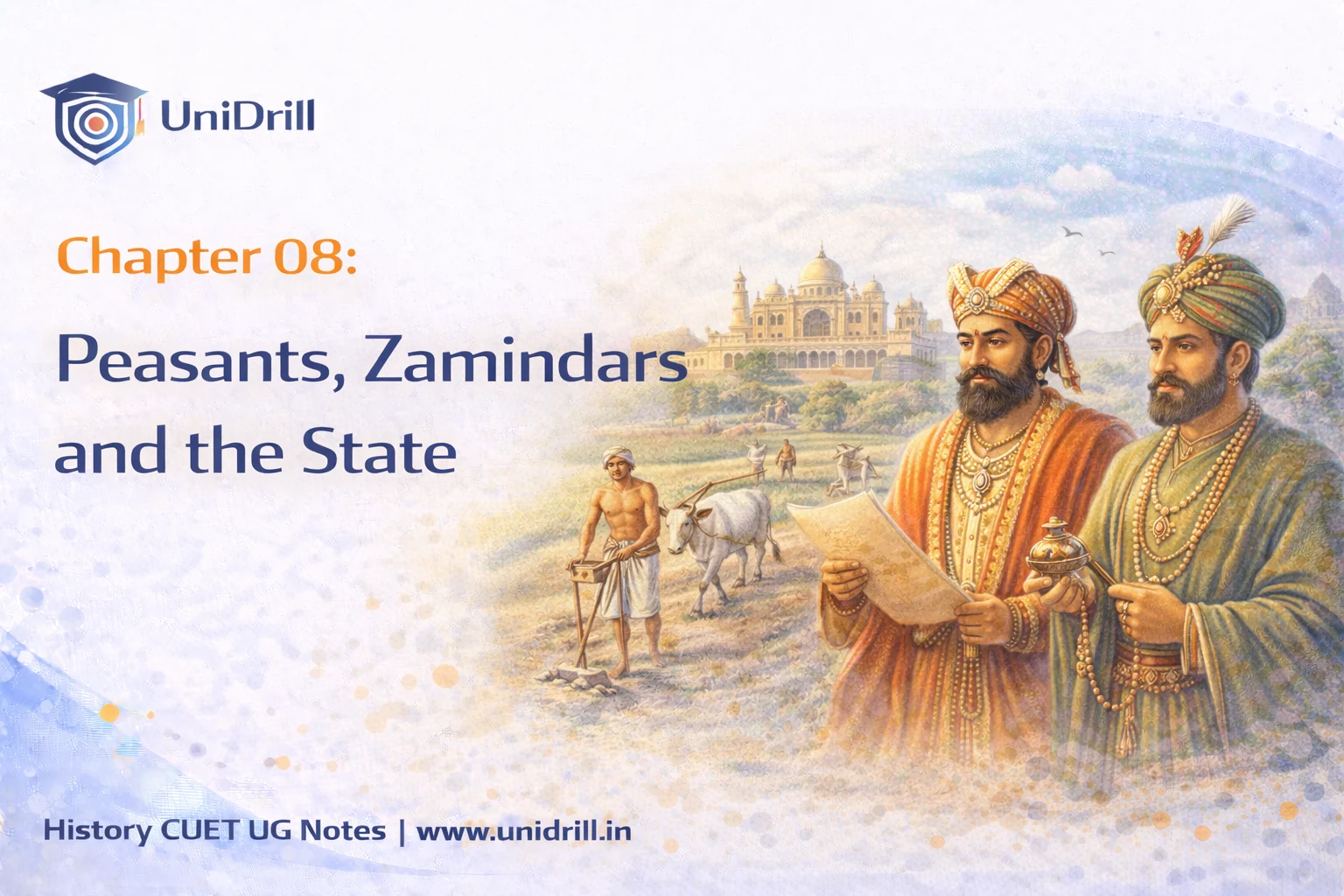
AGRARIAN STRUCTURE AND AGRICULTURAL PRODUCTION
The agrarian structure of Mughal India during the sixteenth and seventeenth centuries formed the backbone of the economy, with nearly 85 per cent of the population residing in villages and directly or indirectly dependent on agriculture.
Rural society was not homogeneous but consisted of multiple groups—peasants, zamindars, and state officials—whose interactions were characterised by cooperation, competition, and conflict.
These relationships collectively shaped what we understand as agrarian society. At the same time, the rural world was not isolated; it was deeply connected to broader economic networks through trade, markets, and monetary transactions, linking villages with towns and urban centres.
Our understanding of this agrarian structure is derived primarily from elite-produced sources, as peasants themselves left no written accounts. The most important of these is the Ain-i Akbari, authored by Abu’l Fazl, which meticulously documents the administrative and revenue arrangements of Akbar’s reign.
However, the Ain represents a top-down perspective, projecting an image of a well-ordered empire under a strong ruling class. It tends to underplay tensions and conflicts within rural society.
Therefore, historians supplement it with regional revenue records and accounts from the East India Company, which provide insights into local conflicts and peasant expectations of justice.
Peasants, referred to in sources as raiyat, muzarian, kisan, or asami, constituted the primary producers in this agrarian system.
They were broadly divided into two categories: khud-kashta, who were resident cultivators with hereditary rights over their land, and pahi-kashta, who were non-resident cultivators cultivating land on a contractual basis.
The latter group often migrated either voluntarily in search of better conditions or due to compulsion arising from economic distress, such as famine. This highlights the mobility of peasants, which was a significant feature of Mughal agrarian society.
Landholding patterns were typically modest. Most peasants owned small plots, often limited to a few acres, and possessed minimal resources such as a pair of bullocks and basic agricultural implements. Despite this, land was treated as private property, which could be bought and sold.
This indicates the existence of a developed system of property rights within the rural economy. The availability of cultivable land, combined with labour mobility and the demand for agricultural output, contributed to the continuous expansion of cultivation.
Agricultural practices were closely tied to environmental conditions, with the monsoon serving as the backbone of agricultural production. However, reliance on rainfall alone was insufficient, especially for certain crops.
As a result, various forms of artificial irrigation were employed. These included wells, tanks, and devices such as the Persian wheel, as described in the Babur Nama. The Mughal state also played an active role by constructing and maintaining canals, such as the shahnahr in Punjab during Shah Jahan’s reign.
The technology used in agriculture was relatively simple yet effective. The wooden plough, often fitted with an iron tip, was designed to avoid deep furrowing, thereby preserving soil moisture.
Seeds were sown using drills or by broadcasting, while weeding and hoeing were carried out manually. These techniques reflect an adaptation to climatic conditions and resource constraints, rather than technological stagnation.
Agriculture followed a dual cropping cycle—the kharif (autumn) and rabi (spring) seasons—allowing for multiple harvests in many regions. This system ensured a remarkable diversity of crops.
While staple crops such as rice, wheat, and millets dominated production, there was also significant cultivation of cash crops, referred to as jins-i kamil (perfect crops), including cotton, sugarcane, oilseeds, and lentils. The Mughal state actively encouraged the cultivation of such crops due to their higher revenue potential.
The seventeenth century witnessed the introduction of new crops from the New World, such as maize, tobacco, potatoes, and chillies, which were gradually integrated into Indian agriculture.
This reflects the growing interconnectedness of global trade networks and their impact on local agrarian systems.
Overall, Mughal agriculture was characterised by a combination of subsistence and commercial production, supported by flexible cropping patterns and expanding cultivation.
This contributed to population growth, estimated at around 33 per cent between 1600 and 1800, despite periodic disruptions caused by famines and epidemics. Thus, the agrarian system was both dynamic and resilient, forming the foundation of Mughal economic strength.
VILLAGE SOCIETY AND SOCIAL RELATIONS
The village was the fundamental unit of agrarian society, functioning as both an economic and social entity. It comprised three principal components: the cultivators, the panchayat, and the village headman (muqaddam or mandal).
While peasants held land as individuals, their social existence was embedded within the collective framework of the village community.
Rural society was deeply marked by caste-based inequalities, which structured access to resources, labour, and social status. Cultivators themselves formed a heterogeneous group, ranging from relatively prosperous peasants to landless labourers and menials.
The latter, often referred to as majur, performed agricultural and other menial tasks and were relegated to the lowest strata of society.
There was a clear correlation between caste, poverty, and marginalisation, particularly at the lower levels of the social hierarchy.
However, the social structure was not entirely rigid. Intermediate castes such as Ahirs, Gujars, and Malis were able to improve their status through economic activities like cattle rearing and horticulture. This indicates a degree of social mobility, albeit limited and uneven.
The panchayat played a central role in regulating village life. It was an assembly of elders, usually drawn from dominant sections of society, and functioned as an oligarchic body. Its decisions were binding on all members of the community.
The panchayat was responsible for maintaining social order, resolving disputes, managing communal resources, and enforcing caste norms. It also collected funds for community welfare activities, such as repairing infrastructure or coping with natural calamities.
The village headman, known as the muqaddam or mandal, acted as the intermediary between the village and the state. He supervised the preparation of village accounts, assisted by the patwari, and ensured the smooth functioning of administrative processes.
However, there is evidence to suggest that headmen often abused their position, manipulating accounts to their advantage and shifting the burden of revenue onto smaller cultivators.
In addition to village-level governance, jati panchayats operated within specific caste groups. These bodies exercised considerable authority, particularly in matters related to marriage, inheritance, and ritual practices.
They also mediated disputes and ensured adherence to caste norms. In most cases, the state respected the decisions of these panchayats, highlighting the autonomy of local institutions.
Conflicts within rural society were common, particularly in relation to revenue demands and forced labour (begar). Peasants often submitted petitions to the panchayat, seeking redress against exploitation by zamindars or state officials.
These petitions reveal a strong sense of moral economy, where peasants believed that the state had an obligation to ensure their subsistence.
When grievances were not addressed, peasants resorted to more drastic forms of resistance, such as deserting their villages, which was made possible by the availability of uncultivated land.
The village economy was characterised by a high degree of interdependence among occupational groups.
Artisans such as potters, blacksmiths, carpenters, and barbers provided essential services to the community. In return, they were compensated through a variety of means, including shares of agricultural produce, land grants, or direct payments.
This system of exchange, later described as the jajmani system, reflects the intricate network of economic relationships within the village.
Importantly, the distinction between cultivators and artisans was often fluid, as many households engaged in both agricultural and craft activities. This diversification of labour ensured economic resilience and efficient utilisation of resources.
The notion of the village as a self-sufficient “little republic,” as proposed by some British officials, is misleading.
While villages exhibited elements of collective organisation, they were far from egalitarian. Power was concentrated in the hands of dominant groups, and significant inequalities existed along lines of caste and gender.
Moreover, villages were integrated into wider economic systems through trade, markets, and cash transactions, challenging the idea of isolation.
POWER STRUCTURES, FORESTS, AND STATE CONTROL
Women played a crucial yet often under-recognised role in agrarian society. They were actively involved in various stages of agricultural production, including sowing, weeding, harvesting, and processing crops.
In addition, women contributed significantly to artisanal activities such as spinning, pottery, and embroidery. The organisation of production at the household level meant that there was no strict separation between domestic and economic spheres.
Despite their economic contributions, women were subject to social and patriarchal constraints. Cultural norms restricted their mobility and autonomy, and they were often excluded from formal records, being identified only in relation to male family members. However, women in peasant and artisan communities enjoyed certain rights not available to elite women, such as widow remarriage and bride-price practices.
In some cases, women held property rights and participated in the land market. There are instances of women inheriting and managing zamindaris, particularly in regions like Bengal. This highlights the complexity of gender relations, where subordination coexisted with limited forms of agency.
Beyond settled agriculture, a significant portion of the subcontinent was covered by forests, which were inhabited by tribal communities.
These groups, referred to as jangli in contemporary sources, engaged in activities such as hunting, gathering, and shifting cultivation. Their livelihoods were seasonal and mobile, reflecting a different mode of existence compared to settled agriculture.
The Mughal state viewed forests as both a resource and a challenge. Forests served as refuges for rebels and were often difficult to control. However, the state also sought to exploit forest resources, particularly elephants for military purposes. This led to the imposition of tribute (peshkash) on forest communities.
Over time, external influences transformed tribal societies. The expansion of commercial agriculture and trade increased the demand for forest products such as honey, wax, and lac.
Some tribal chiefs accumulated power and became zamindars or kings, integrating into the broader political structure. Cultural changes also occurred, including the spread of Islam through the influence of Sufi saints.
Zamindars occupied a crucial position in the agrarian hierarchy. They were landed elites who derived income from agriculture without directly participating in cultivation.
Their power was based on ownership of land (milkiyat), rights to collect revenue, and control over military resources. They often maintained armed forces and fortifications, reinforcing their authority.
Zamindars played a significant role in the expansion of agriculture by settling cultivators and providing resources such as loans. While they were often exploitative, their relationship with peasants was also characterised by elements of patronage and reciprocity. In many instances, zamindars supported peasant uprisings against excessive state demands, indicating a complex alignment of interests.
The Mughal land revenue system was the cornerstone of the empire’s economy. It involved a systematic process of assessment (jama) and collection (hasil), supported by a sophisticated administrative apparatus.
The state attempted to measure all cultivable land and classify it based on productivity, as seen in Akbar’s classification of land into polaj, parauti, chachar, and banjar categories.
Revenue could be collected in both cash and kind, using various methods such as kankut (estimation) and batai (division of produce). This flexibility allowed the system to adapt to local conditions.
However, the primary objective remained the maximisation of state revenue, which often placed a heavy burden on peasants.
Finally, the Mughal economy was influenced by global trade dynamics, particularly the influx of silver from Europe.
This influx facilitated the expansion of a monetised economy, enabling the state to collect taxes in cash and supporting the growth of markets and trade networks. India emerged as a major centre of global commerce, with its agricultural and artisanal products in high demand.