
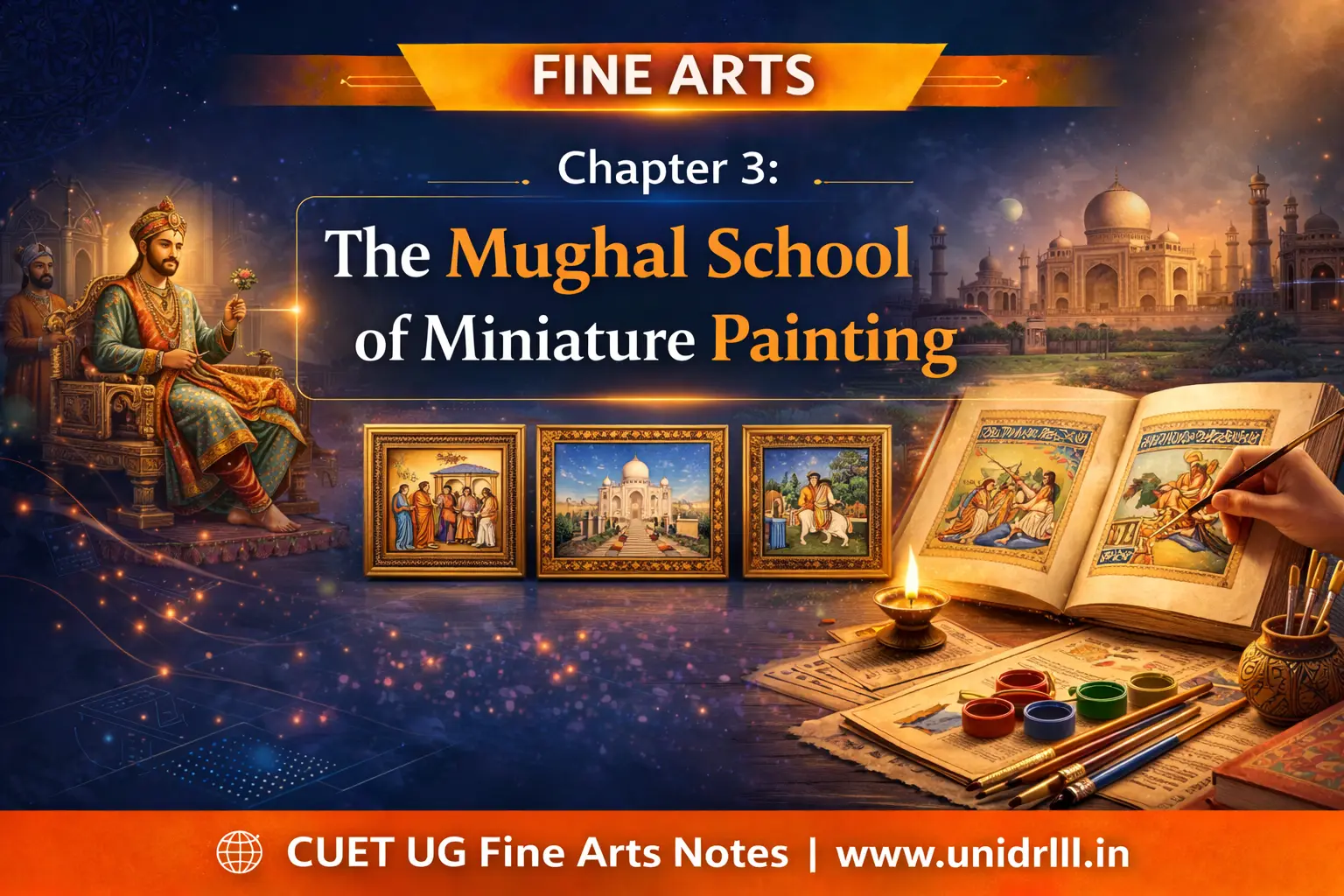
Foundations, Context, and Stylistic Synthesis
The Mughal School of Miniature Painting developed in the northern Indian subcontinent during the sixteenth century and continued to flourish until the mid–nineteenth century.
It is distinguished by its sophisticated techniques, diverse themes, and its lasting influence on later schools of Indian painting.
This style occupies a significant and definitive place within the broader tradition of Indian art, not only because of its aesthetic achievements but also due to its syncretic and inclusive character.
The emergence and development of Mughal painting cannot be understood without recognising the crucial role played by Mughal patronage. The Mughal emperors were great connoisseurs of art and actively supported various forms such as painting, calligraphy, architecture, and manuscript illustration.
Each ruler contributed according to his personal taste and aesthetic sensibility, thereby enriching the artistic environment of the time. The establishment of royal ateliers marked an important development, where artists worked collectively under imperial supervision.
These ateliers became centres of innovation and refinement, nurturing new styles while elevating existing artistic traditions.
A defining characteristic of Mughal painting is its ability to assimilate diverse influences. The Mughal style represents a harmonious amalgamation of indigenous Indian elements with Persian traditions and later, European artistic ideas.
This synthesis resulted in a highly sophisticated visual culture that combined Islamic, Hindu, and European aesthetics. The artworks of this period reflect not merely a blending of styles but a deeper integration of philosophies, beliefs, and cultural expressions. Such inclusivity allowed Mughal painting to surpass earlier Indian and Iranian traditions in terms of complexity and richness.
The Mughal atelier was a highly organised institution comprising calligraphers, painters, gilders, and binders. Paintings were typically created as part of manuscripts and albums, where text and image coexisted within a carefully designed format.
These works were primarily intended for the royal court and were often meant to record significant events, personalities, and imperial interests. At the same time, they served as intellectual stimuli for the elite, reflecting refined tastes and scholarly engagement.
It is important to note that Mughal painting did not evolve in isolation. It developed through continuous interaction with pre-existing Indian and Persian traditions. Indigenous Indian painting styles were characterised by flat perspectives, bold lines, vivid colours, and stylised forms.
In contrast, Mughal painting introduced subtle modelling, delicate shading, and an almost three-dimensional quality. This marked a significant shift towards optical realism and naturalistic representation. The coexistence of these traditions led to mutual enrichment, resulting in a distinctive artistic idiom.
The thematic range of Mughal painting was equally diverse. Artists depicted royal court scenes, historical events, portraits of emperors and nobles, as well as detailed studies of flora and fauna.
These subjects were treated with great precision and attention to detail, reflecting both artistic skill and intellectual curiosity. The emphasis on realism, combined with refined aesthetics, gave Mughal painting a unique character.
In conclusion, the Mughal School of Miniature Painting represents a sophisticated and courtly art form shaped by imperial patronage, cultural synthesis, and technical excellence. Its ability to integrate diverse traditions while maintaining a distinct identity marks it as one of the most significant achievements in the history of Indian art.
Chronological Development (Babur to Jahangir)
The development of Mughal painting can be best understood through a chronological study of the reigns of successive emperors, each of whom contributed uniquely to its evolution.
The foundation was laid by Babur, the first Mughal emperor, who came to India in 1526. A descendant of Timur and Chaghtai Turks, Babur brought with him a rich cultural heritage rooted in Central Asian and Persian traditions.
He was a man of refined taste and a keen observer of nature, as reflected in his autobiography, the Baburnama. His writings reveal a deep appreciation for landscape, flora, fauna, and portraiture.
Although his reign in India was brief, he established a tradition of recording events and experiences, which later became an important aspect of Mughal art.
Babur was succeeded by Humayun, whose reign marked a significant turning point in the history of Mughal painting. After being dethroned, Humayun sought refuge in the court of the Safavid ruler Shah Tahmasp in Persia.
During his exile, he was exposed to the highly developed Persian tradition of miniature painting. Inspired by this artistic excellence, Humayun invited two renowned Persian artists, Mir Sayyid Ali and Abd us Samad, to his court.
He also established a painting workshop known as the Nigaar Khana. These developments laid the foundation for a new artistic tradition in India, characterised by Persian techniques and aesthetics.
The early Mughal style under Humayun was predominantly Persian in character, evident in its colour schemes, compositions, and decorative elements.
However, this style gradually evolved as it absorbed indigenous Indian influences, leading to the emergence of a distinct Mughal idiom.
The reign of Akbar marked the most significant phase in the development of Mughal painting. A great patron of the arts, Akbar employed more than a hundred artists in his royal atelier, including both Persian and Indian painters. This diverse group of artists collaborated on large-scale projects, resulting in the creation of a unique Indo-Persian style.
One of the earliest and most ambitious projects undertaken during Akbar’s reign was the Hamza Nama, an illustrated manuscript depicting the adventures of Hamza.
This work is notable for its large size, dynamic compositions, and vibrant colours. It reflects the collaborative nature of Mughal painting, where multiple artists contributed to a single work.
Akbar also initiated the translation and illustration of important Sanskrit texts into Persian, including the Mahabharata (known as the Razm Nama) and the Ramayana.
These projects not only enriched Mughal art but also promoted cultural integration. The Akbar Nama, a detailed account of Akbar’s life and achievements, stands as another significant artistic and historical document.
Under Akbar, Mughal painting expanded its thematic scope to include court scenes, battles, portraits, and mythological narratives.
The style became more dynamic and naturalistic, with improved spatial organisation and greater attention to detail. The introduction of European influences, particularly through contact with missionaries and traders, further enriched the visual language.
Paintings such as Madonna and Child demonstrate the assimilation of European themes and techniques.
The reign of Jahangir represents the pinnacle of Mughal painting in terms of refinement and naturalism. Unlike Akbar, who emphasised large-scale production, Jahangir preferred fewer but more finely executed works.
He had a keen interest in nature and sought scientific accuracy in the depiction of flora and fauna.
Under Jahangir, the focus shifted towards individual artists and the production of album paintings, known as Muraqqas. These works were characterised by intricate detailing, delicate brushwork, and richly decorated borders.
Portraiture reached new heights of realism, capturing not only physical likeness but also the personality and status of the subject.
European influence became more pronounced during this period, contributing to the development of perspective, shading, and spatial depth. Symbolism and allegory were also widely used, as seen in paintings that depict imperial authority and political themes.
Thus, the period from Babur to Jahangir witnessed the transformation of Mughal painting from its Persian roots to a mature and highly refined artistic tradition.
Maturity, Decline, Techniques, and Legacy
The Mughal School of Painting reached a stage of grandeur and opulence during the reign of Shah Jahan. Inheriting a well-established artistic tradition, Shah Jahan encouraged the creation of works that emphasised elegance, refinement, and idealisation.
Unlike the naturalism of Jahangir’s period, the paintings of this era focused on stylisation and aesthetic perfection.
The use of rich, jewel-like colours, intricate detailing, and fine lines became prominent features. The compositions were carefully planned to convey a sense of grandeur and magnificence.
Imperial portraits were idealised to project the authority and majesty of the emperor. One of the most notable works of this period is the Padshahnama, which represents the height of Mughal miniature painting.
It showcases sophisticated compositions, multiple perspectives, and an exquisite colour palette.
Dara Shikoh, the son of Shah Jahan, was a scholar and a patron of the arts who showed deep interest in Sufi mysticism and Vedantic philosophy.
His intellectual pursuits and inclusive outlook are reflected in the artworks associated with him, which emphasise spiritual and cultural synthesis.
The decline of Mughal painting began during the reign of Aurangzeb, who did not extend the same level of patronage to the arts as his predecessors.
Although the royal atelier was not immediately disbanded, the lack of imperial support led to a gradual decline in artistic production.
Many skilled artists left the Mughal court and found patronage in provincial courts, where they contributed to the development of regional styles.
In the later Mughal period, particularly under rulers such as Bahadur Shah Zafar, the once-flourishing tradition of miniature painting saw only sporadic activity.
The changing political environment, including the rise of British power, further altered the artistic landscape. Eventually, the Mughal style merged into other traditions, such as the Provincial and Company Schools.
The process of Mughal painting was highly systematic and involved several stages. Handmade paper was prepared and cut according to the size of the manuscript.
Space was allocated for both text and image. After the text was written, the artist created a visual composition that corresponded to it. The process included stages such as tarh (composition), chiharanama (portraiture), and rangamizi (colouring).
The colours used in Mughal paintings were derived from natural sources. Pigments such as vermilion, ultramarine, and orpiment were carefully prepared to achieve the desired shades.
Brushes made from animal hair were used for painting. The finished work was often burnished with a gemstone to enhance its brightness and durability. Gold and silver were frequently used to add richness and ornamentation.
Mughal painting was typically a collaborative effort, with different artists specialising in various aspects such as drawing, colouring, and detailing. This division of labour ensured high quality and efficiency in production.
In conclusion, the Mughal School of Miniature Painting represents a remarkable achievement in the history of art. It embodies a unique synthesis of cultural influences, technical mastery, and intellectual depth.
Despite its eventual decline, its legacy continued to inspire subsequent artistic traditions in India and beyond, securing its place as one of the most refined and influential schools of painting in the world.